Article on the AI economy
AI and the future of work
AI is changing work task by task, not job by job. Here is what is shifting, why humans stay in the loop, and how it connects to compute, with real data and sources.
Key takeaways
- AI tends to change work at the task level first, automating parts of jobs rather than whole roles at once.
- McKinsey finds the largest effects in customer operations, marketing and sales, software engineering, and research and development.
- The Stanford AI Index reports that AI agents still fail roughly one in three attempts, so human oversight remains essential.
- As more work runs through AI, the compute behind it grows, keeping demand for GPU hardware high.
AI changes tasks before it changes jobs
Most jobs are bundles of many tasks. AI rarely replaces an entire job in one step. Instead, it takes on specific tasks within a role, such as drafting a first version, summarizing a long document, or writing routine code. The job then reshapes around the tasks that remain, which are often the ones that need human judgment.
This matters for how change actually feels day to day. Rather than sudden mass replacement, the more common pattern is workers spending less time on repetitive tasks and more time on judgment, review, client relationships, and the parts of the work that genuinely need a person. The role changes shape even when the job title stays the same.
Seeing work as a set of tasks rather than a single block also helps explain why two people with the same job title can be affected very differently. The mix of tasks varies from person to person, and so does the share that AI can usefully take on, which is why broad predictions about specific jobs are so often wrong.
Where the change starts first
According to McKinsey, the functions with the largest potential are customer operations, marketing and sales, software engineering, and research and development. These are language-heavy and analysis-heavy areas, so they feel AI first and most strongly, and they tend to be where the earliest productivity numbers appear.
That does not mean other roles are untouched. It means the early, visible changes cluster in a few functions, and the lessons learned there spread outward over time as tools and habits mature. A workflow proven in customer support often gets adapted for other teams a year or two later.
For workers, this points to a practical question worth asking honestly: how much of my day is spent on the kind of routine language, code, or analysis that AI handles well, and how much is judgment, relationships, or physical work that it does not? The answer shapes how the role is likely to evolve and where to focus on building new skills.
How roles tend to shift around AI
Less routine drafting
First drafts, summaries, and boilerplate get faster, freeing time that used to go to repetitive production work.
More review and judgment
People spend more time checking, editing, and deciding, since the output still needs a responsible human to stand behind it.
New oversight skills
Knowing how to direct AI tools and verify their work becomes a valuable skill in its own right, distinct from the underlying craft.
Higher throughput
Teams handle more volume with the same headcount, which is exactly where measured productivity gains tend to appear.
People and AI, working together
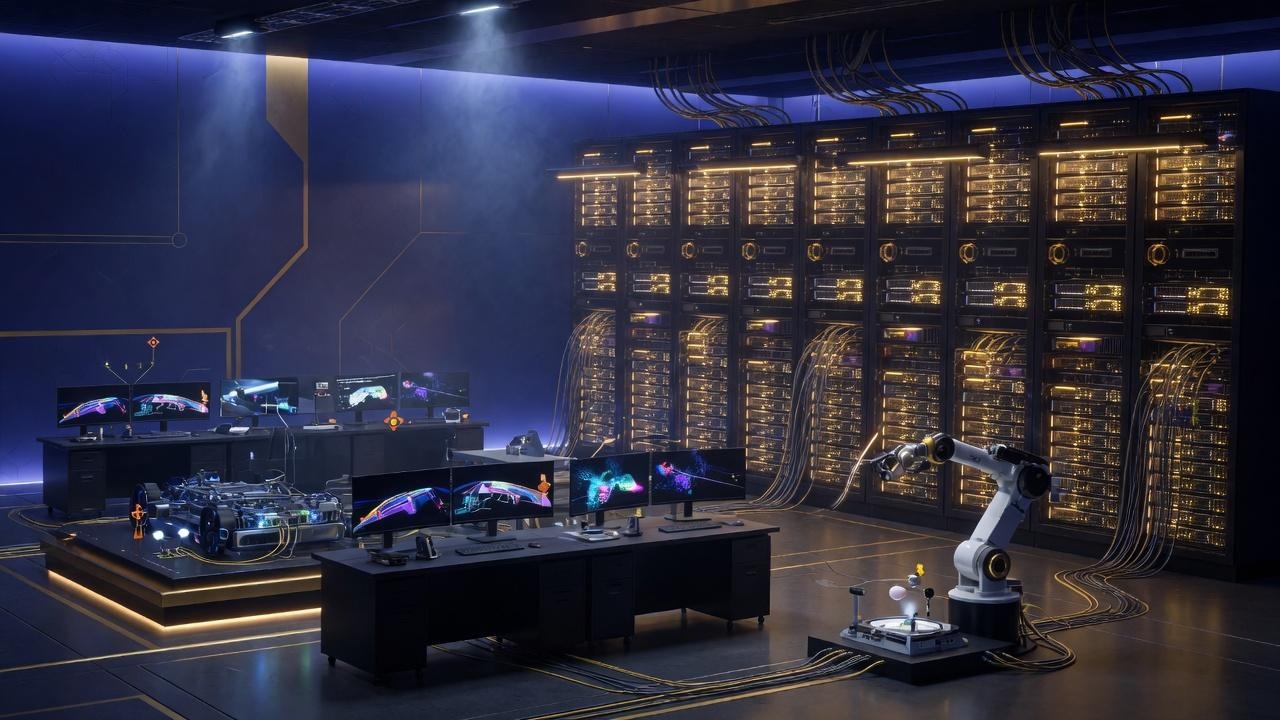
The most common arrangement emerging is not people replaced by machines, but people supervising and directing them. The worker sets the goal, the model handles a draft, and the worker checks and refines until the result is good enough to ship.
That collaboration is only possible because reliable compute is running underneath every assisted task, often without the worker ever thinking about it. The smoothness of the experience hides a busy data center doing the heavy lifting.
Why humans stay in the loop
AI is capable but not reliable enough to run without supervision in most serious settings. The Stanford AI Index reports that AI agents are improving but still fail roughly one in three attempts. That failure rate is exactly why human review remains central rather than optional, especially when the cost of a mistake is high.
The realistic future of work is not people versus AI. It is people using AI to move faster while staying responsible for the result. The skill that grows in value is knowing how to direct these tools, spot when they are wrong, and check their output before it ships to a customer or a colleague.
This also tempers fears of overnight job loss. A tool that fails one in three attempts cannot be left unattended on important work, so the near-term story is augmentation under human control rather than full automation. The need for a responsible person in the loop is a feature of the current technology, not a temporary inconvenience.
Augmentation and full automation, side by side
| Aspect | Augmentation (common today) | Full automation (rarer) |
|---|---|---|
| Who is responsible | A person reviews and signs off | The system acts without review |
| Best fit | High-value or sensitive work | Narrow, low-risk, repetitive tasks |
| Effect on roles | Roles reshape around judgment | Specific tasks disappear from the role |
| Fit with current reliability | Matches a one-in-three failure rate | Hard to justify until reliability improves |
How workers and teams adapt well
The people who benefit most tend to treat AI as a power tool rather than a threat or a gimmick. They learn where it is strong, where it is weak, and how to fold it into their workflow so the routine parts shrink and the valuable parts grow. That mindset matters more than any single feature of the tools.
Organizations adapt well when they invest in training and clear guidelines instead of leaving everyone to figure it out alone. Because the technology fails sometimes, good process around it, including review steps and clear lines of responsibility, matters as much as the tool itself.
None of this happens instantly. Like past workplace technologies, AI rewards teams that build habits and standards around it over time, not those expecting a single switch to flip. The teams that move steadily and learn from each project tend to pull ahead of those chasing a dramatic overnight change.
More AI work means more compute
As AI takes on more tasks across more roles, the volume of model runs increases. Every assisted task is compute running on a GPU somewhere. The future of work and the demand for AI compute are two sides of the same shift, even though one is visible on screens and the other is hidden in data centers.
That link is why some people look beyond using AI tools and consider owning the hardware that produces AI compute. One response is managed GPU ownership, where a professional team hosts and operates physical hardware you own inside American data centers, so you hold the asset without running the equipment yourself.
This promises no specific result. Operational benefits are not guaranteed and depend on utilization, uptime, demand, costs, hardware performance, and market conditions.
References and data
- The economic potential of generative AI: The next productivity frontier. McKinsey and Company. June 2023.
- The 2026 AI Index Report. Stanford Institute for Human-Centered AI (HAI). April 2026.
Common questions about AI and work
Usually not all at once. AI tends to automate specific tasks within a role first, so jobs reshape around the work that remains. McKinsey finds the strongest effects in functions like customer operations, marketing and sales, software engineering, and research and development.
Not reliably yet. The Stanford AI Index reports that AI agents still fail roughly one in three attempts, so human oversight and review remain essential in most serious settings.
Skills around directing AI tools and verifying their output rise in value. Because models still make mistakes, the ability to set clear goals, review results, and take responsibility for the final work becomes a core part of many roles.
Augmentation means a person uses AI to work faster while staying responsible for the result, which fits most work today. Full automation means the system acts without review, which suits only narrow, low-risk tasks given current reliability.
Begin with routine, high-volume tasks rich in language, code, or analysis, provide training and clear guidelines, and keep a human responsible for checking output. Building habits and process around the tool matters as much as the tool itself.
As AI takes on more tasks across more roles, the number of model runs grows. Each one is compute on a GPU, so wider use of AI at work pushes demand for GPU hardware and infrastructure higher.
Talk with us about AI infrastructure ownership
Share your name, phone, email, and which managed device tier interests you. We will reach out with a clear walkthrough. No pressure.
Request received
Thank you. We will contact you at the phone number or email you provided.
Want a real position in AI compute?
Talk through what owning managed NVIDIA GPU hardware would look like, with no pressure and straight answers.
Operational benefits are not guaranteed and depend on utilization, uptime, demand, costs, hardware performance, and market conditions.