Article on AI compute demand
AI agents and rising inference demand
AI agents do not answer once and stop. They reason, retry, and call models many times per task. Here is why that multiplies inference demand, with real data.

Key takeaways
- Agents make many model calls per task, so they multiply inference demand compared with a single chat reply.
- AI agents still fail about 1 in 3 attempts, according to the Stanford AI Index, which means retries add even more compute.
- AI-focused data centre electricity surged about 50 percent in 2025, according to the IEA.
- Rising inference, not just training, is a growing reason GPU compute stays scarce.
From single answers to autonomous agents
Inference is the compute used to run a finished AI model. A simple chatbot reply is one inference call: a question goes in, an answer comes out. AI agents change that pattern entirely. An agent breaks a goal into steps, calls a model repeatedly to plan, act, check its work, and try again until the task is done.
That shift matters for compute. Where a single answer might take one call, an agent completing a task might take dozens. As agents spread into software development, research, customer support, and operations, the total number of inference calls multiplies far faster than the number of users would suggest.
The key change is structural. With chatbots, demand scaled roughly with how many people were typing. With agents, demand scales with how many tasks are running and how many steps each one takes, a number that can grow even while the human headcount stays flat.
What the data shows
~50%
Surge in AI-focused data centre electricity in 2025, according to the IEA.
Source: International Energy Agency (IEA), 2025
1 in 3
Share of attempts where AI agents still fail, which drives extra retries, according to the Stanford AI Index.
Source: Stanford Institute for Human-Centered AI (HAI), April 2026
~17%
Growth in overall global data centre electricity demand in 2025, according to the IEA.
Source: International Energy Agency (IEA), 2025
Why imperfect agents use even more compute
Agents are not yet reliable. The Stanford AI Index notes that AI agents still fail about 1 in 3 attempts. Failure is not free. When an agent gets a step wrong, it often retries, takes a different path, or runs extra checks, and every one of those is another inference call that consumes compute.
So the very thing that makes agents promising, their ability to keep working at a problem until it is solved, also makes them compute hungry. As they improve, more tasks become worth automating, which raises total demand even if each individual task gets cheaper to run.
This is the counterintuitive part. Better, more reliable agents do not necessarily reduce compute demand. By making automation worthwhile for a wider range of tasks, they tend to expand the total amount of work being handed to models.
The always-on workload behind agents
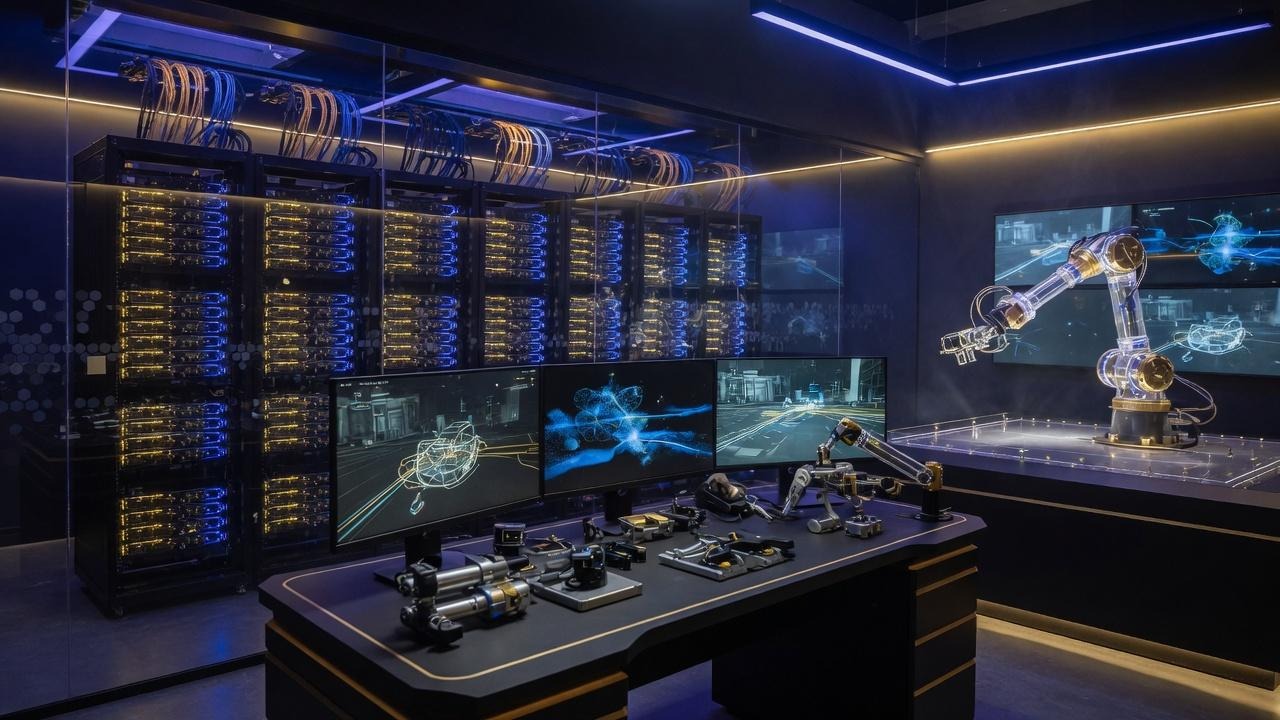
Unlike a person who logs off at night, agents can run continuously. Operations centers like this one monitor workloads that never fully stop, which is part of why inference is becoming a steady base load on data centers rather than a daytime peak.
Adoption is already showing up in the grid
This is not a forecast for some distant year. The IEA reports that AI-focused data centre electricity surged about 50 percent in 2025, while overall data centre demand grew about 17 percent. Major model providers reported a roughly threefold rise in active users over the past year, according to the IEA.
More users and more agents both point the same direction. Inference, the everyday running of models, is becoming a larger and larger share of why GPU compute stays in short supply. The grid figures are an early, measurable signal of a workload that is still in its early growth.
What makes this shift important is its durability. A single viral product can spike demand and then fade, but agents embedded in software, support, and operations create a baseline of usage that does not switch off. As that baseline rises, it changes how operators plan, because they must provision for steady around-the-clock inference rather than occasional peaks.
Why one task can mean many calls
Planning steps
An agent often calls a model just to break a goal into a plan, then again to refine that plan, before any real work begins.
Tool use and checks
Agents call models to decide which tool to use, interpret the result, and verify whether a step succeeded, each of which is its own inference call.
Retries on failure
When a step fails, the agent reasons about what went wrong and tries again. With failure rates near 1 in 3, retries add up quickly across a task.
Where agentic workloads are showing up
Agents are moving out of demos and into real workflows. In software development, they read code, propose changes, run tests, and revise their work across many steps. In research and analysis, they gather sources, draft, and check findings. In customer operations, they handle multi-step requests that once needed a person. Each of these patterns multiplies model calls per task.
What ties them together is autonomy. Instead of a single prompt and reply, an agent runs a loop of plan, act, and check until a goal is met. The IEA reports that AI-focused data centre electricity surged about 50 percent in 2025, and the spread of these multi-step workloads is one of the forces behind that jump.
As more software is built to call models automatically, the line between a user and a workload blurs. A handful of people can set off thousands of agent runs, which is why inference demand is starting to scale with tasks and automation rather than with headcount alone.
Why steady inference demand favors owned hardware
Rising inference is a steady, broad-based source of demand for compute, not a one-time spike. That steadiness is part of why holding a position in GPU hardware appeals to people who believe AI use will keep growing. The managed ownership model lets you own the physical hardware while a professional team keeps it running and connected to demand.
It is worth being clear-eyed about the uncertainty, though. The fact that inference is rising broadly does not mean any single piece of hardware will always be in demand. Workloads move between hardware generations, pricing shifts, and newer chips can change what providers want to run. A steady trend across the industry is not the same as a promise about one machine.
Our service on managed GPU compute explains how that works. Demand can still shift, and owning hardware does not guarantee any outcome. Operational benefits are not guaranteed and depend on utilization, uptime, demand, costs, hardware performance, and market conditions.
References and data
- The 2026 AI Index Report. Stanford Institute for Human-Centered AI (HAI). April 2026.
- Key Questions on Energy and AI. International Energy Agency (IEA). 2025.
Common questions about AI agents and inference
A chatbot reply is usually one inference call. An agent breaks a goal into steps and calls a model many times to plan, act, and check its work, so a single task can take dozens of calls and far more compute.
Yes. The Stanford AI Index notes AI agents still fail about 1 in 3 attempts. Failed steps trigger retries and extra checks, and each one is another inference call, so imperfect agents use even more compute.
Not necessarily. More reliable agents make automation worthwhile for more tasks, which tends to expand the total amount of work handed to models. Efficiency per task can rise while total demand still grows.
The IEA reports AI-focused data centre electricity surged about 50 percent in 2025, with overall data centre demand up about 17 percent. Wider AI usage is already visible in electricity figures.
Agents can run continuously rather than only when a person is typing. That turns inference into an around-the-clock base load on data centers instead of a daytime peak, which keeps hardware busy and in demand.
Talk with us about AI infrastructure ownership
Share your name, phone, email, and which managed device tier interests you. We will reach out with a clear walkthrough. No pressure.
Request received
Thank you. We will contact you at the phone number or email you provided.
Want a position in steadily rising compute demand?
Talk through what owning managed NVIDIA GPU hardware would look like, with no pressure and straight answers.
Operational benefits are not guaranteed and depend on utilization, uptime, demand, costs, hardware performance, and market conditions.