Article on AI hardware basics
What is a GPU, and why does AI need it
The graphics processing unit is the engine behind modern artificial intelligence. Here is what a GPU actually is, in plain language, and why AI depends on it.
Key takeaways
- A GPU is a processor designed to do many small calculations at the same time, which is exactly what AI needs.
- Training and running AI models is mostly parallel math, the kind of work GPUs handle far better than ordinary processors.
- Training compute for frontier AI models has grown roughly 4 to 5 times per year since 2010, according to Epoch AI.
- Because AI leans so heavily on GPUs, this hardware has become one of the most valuable resources in technology.
What a GPU actually is
A graphics processing unit, or GPU, is a specialized computer chip built to perform a huge number of calculations at the same time. It was originally designed to draw images on a screen, where millions of pixels need to be updated together many times each second. That work is naturally parallel, meaning it can be split into many small pieces that run side by side rather than one after another.
Inside a single GPU sit thousands of small processing cores, along with dedicated high-speed memory and the circuitry that feeds those cores with data. None of those cores is especially powerful on its own. Their strength comes from numbers. When a problem can be broken into thousands of identical small steps, a GPU can attack all of them at once instead of working through them in a line.
Over time, engineers realized that the same design that makes a GPU good at drawing images also makes it good at any task that involves a lot of simple math repeated across large amounts of data. That insight turned the GPU from a graphics tool into the core engine of modern computing, and eventually into the hardware that artificial intelligence is built on.
The shift from graphics to AI was not an accident of marketing. Rendering a 3D scene and training a neural network turn out to be the same shape of problem underneath. Both apply simple arithmetic to enormous grids of numbers, over and over, with little branching in between. When researchers began experimenting with deep learning in the early 2010s, they found GPUs could train models in a fraction of the time ordinary processors needed, which pulled the GPU to the center of the field.
Why parallel math matters
A traditional processor, the CPU, is built to do a few complex tasks very quickly, one after another. It is excellent at logic, decision making, and work that has to happen in a strict order. A GPU takes the opposite approach. It packs thousands of smaller cores that each handle a simple calculation, so it can work on thousands of numbers at once.
Artificial intelligence is built on exactly this kind of work. Training and running a model means multiplying and adding enormous grids of numbers, the same operation repeated billions of times. Spreading that across thousands of cores is what makes AI practical, and it is why a GPU can finish in hours what a CPU might take weeks to do.
The size of the gap is what surprises people. For the right kind of math, a single data center GPU can do the work of dozens or hundreds of general purpose processors. That is not because the GPU is smarter. It is because the GPU is shaped to match the problem, and AI happens to be exactly the problem it was shaped for. A useful way to picture it is one expert solving a single hard puzzle compared with a thousand helpers who each fill in one square of a giant grid at the same moment. For a job made of billions of nearly identical squares, the crowd finishes while the lone expert is still working through the first row, which is why the parallel design wins so decisively on AI work.
What makes a GPU good at AI
Thousands of cores
Many small cores let a GPU run the same calculation across huge batches of numbers at the same time.
High-speed memory
Dedicated onboard memory keeps the model and its data close to the cores so they rarely sit waiting.
Wide data paths
Fast internal connections move large blocks of numbers in and out so the cores stay fed with work.
Built to link up
AI GPUs are designed to connect to other GPUs, so many can act as one larger machine for big models.
What the hardware looks like in practice
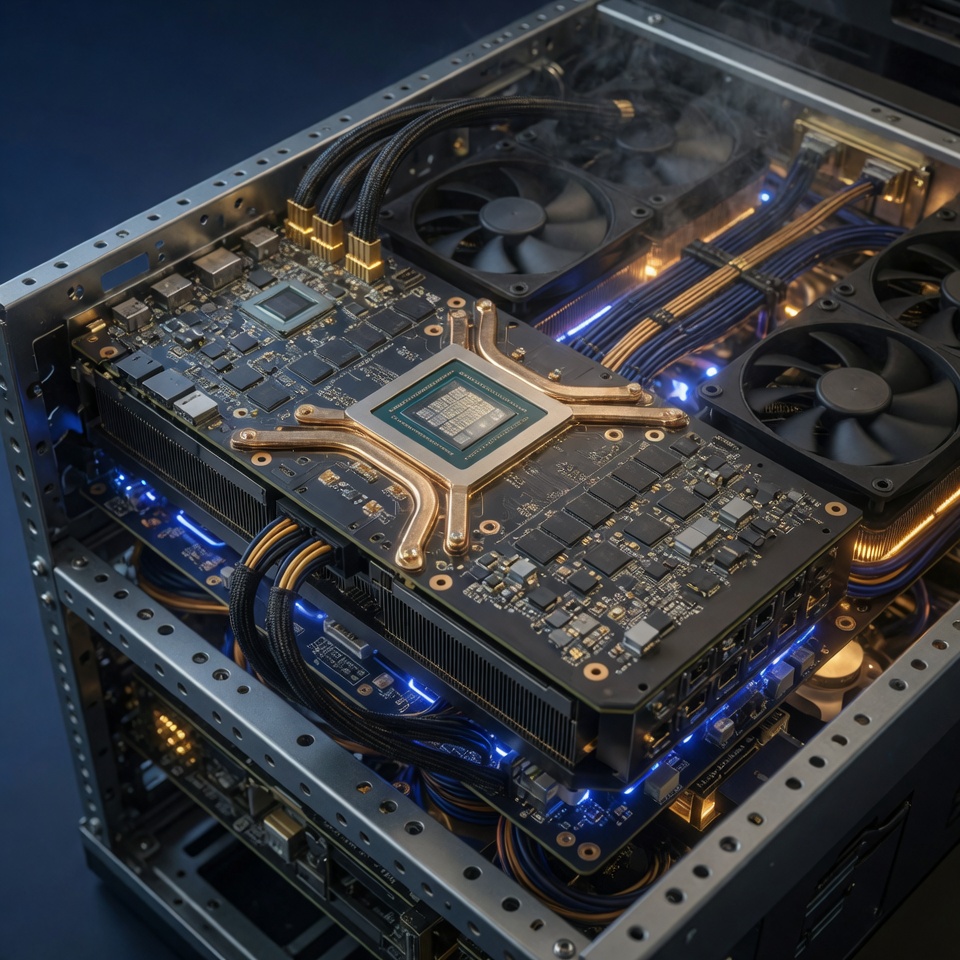
A diagram of cores and memory is useful, but in the real world a GPU is a dense card that slots into a server, drawing heavy power and producing a lot of heat. Several of these cards sit in a single chassis, and many chassis fill a rack. This is the hardware that turns the idea of parallel math into actual AI capability.
How fast AI compute has grown
4 to 5x
Annual growth in training compute for frontier AI models since 2010, according to Epoch AI.
Source: Epoch AI, May 2024
Trillion
Parameter scale that NVIDIA built the Blackwell GPU platform to handle, according to NVIDIA.
Source: NVIDIA Newsroom, March 2024
Why AI depends on GPU hardware
Modern AI models are made of billions of numbers called parameters, and adjusting all of them during training requires staggering amounts of computation. Epoch AI finds that the compute used to train frontier AI models has grown roughly 4 to 5 times per year since 2010. No general purpose processor can keep up with that demand at a reasonable cost or speed.
Hardware makers have leaned into this reality. NVIDIA introduced the Blackwell platform built around the GPU as the central compute engine for trillion-parameter scale AI training and inference. Each generation is designed to hold larger models and move data between cores faster, because model size keeps climbing.
The result is a tight loop. Bigger models need more GPU capacity, more capacity makes bigger models possible, and so the appetite for this hardware keeps growing. That is why GPUs, rather than software alone, increasingly decide which organizations can build advanced AI and which cannot. It also means a clever idea is no longer enough on its own. A team can design a strong model on paper and still be unable to train it without access to enough GPUs, which is part of why the hardware itself, not just the research, has become the thing organizations race to secure.
Common misconceptions about GPUs
One common misconception is that a faster single chip is all that matters. In practice, raw speed is only part of the story. Memory size decides how large a model a GPU can hold, and the connections between GPUs decide how well many of them work together. A balanced system often beats a faster but narrower one.
Another misconception is that the gaming card in a home computer is the same as the hardware behind serious AI. Consumer cards can run smaller tasks, but the largest models depend on data center GPUs with far more memory, faster links, and the ability to run at full load for weeks. The names are similar, but the engineering and the price are not.
A final misconception is that owning a GPU is the same as having useful AI compute. A chip only delivers value when it is housed, powered, cooled, networked, and operated well. Idle or poorly run hardware wastes most of its potential, which is why operation matters as much as the chip itself.
From understanding GPUs to owning them
Because AI runs on GPUs, the hardware itself has become a valuable and scarce resource. That has created a question for people who want a real position in AI compute. Renting time on someone else's machines is one path. Owning the physical hardware and having a professional team operate it is another.
Golden Core Mining focuses on that second path, where you hold managed NVIDIA GPU hardware and an operations team runs the day to day work of power, cooling, monitoring, and connection to demand. To see how that looks in practice, explore our managed GPU compute service.
None of this is a promise of any particular result. Owning hardware does not guarantee an outcome. Operational benefits are not guaranteed and depend on utilization, uptime, demand, costs, hardware performance, and market conditions.
References and data
- NVIDIA Blackwell Platform Arrives to Power a New Era of Computing. NVIDIA Newsroom. March 2024.
- Training compute of frontier AI models grows by 4 to 5x per year. Epoch AI. May 2024.
Common questions about GPUs and AI
GPU stands for graphics processing unit. It is a chip originally designed to render images, built to perform many calculations at the same time. That parallel design is what makes it useful for artificial intelligence.
A CPU is built to handle a few complex tasks in sequence, while AI workloads involve huge amounts of simple math done in parallel. A GPU has thousands of cores that work at once, so it handles AI far faster and more efficiently than a CPU. For large models, a GPU can do work in hours that a CPU might take weeks to complete.
Consumer graphics cards can run smaller AI tasks, but the largest models rely on data center GPUs with more memory and faster connections. These are the same chips that data centers race to secure for serious AI work, and they are engineered to run continuously rather than in short bursts.
A core is a small unit that performs calculations. A GPU has thousands of them because AI math can be split into thousands of identical small steps. Running those steps at the same time, rather than one after another, is what gives a GPU its speed on AI workloads.
Yes. The amount of memory on a GPU sets a limit on how large a model it can hold and how much data it can work on at once. Two GPUs with similar speed can deliver very different results if one has far more memory, which is why AI GPUs carry large amounts of it.
Demand for AI compute has grown faster than the supply of advanced GPUs and the data centers and power needed to run them. Because so much AI is built on this hardware, organizations compete to secure it, which keeps capable GPUs scarce and valuable.
They matter for both. Training a model is the most intense phase, but every time someone uses a finished model, a GPU runs the math behind that answer. Because popular models serve millions of requests a day, this everyday use keeps GPUs busy long after training is complete, which is a large part of why demand for the hardware never really settles down.
Talk with us about AI infrastructure ownership
Share your name, phone, email, and which managed device tier interests you. We will reach out with a clear walkthrough. No pressure.
Request received
Thank you. We will contact you at the phone number or email you provided.
Want a real position in the hardware behind AI?
Talk through what owning managed NVIDIA GPU hardware would look like, with no pressure and straight answers.
Operational benefits are not guaranteed and depend on utilization, uptime, demand, costs, hardware performance, and market conditions.