Article on AI hardware design
What is an AI accelerator?
An AI accelerator is hardware built to make artificial intelligence faster and more efficient. Here is what that means and why these chips exist.

Key takeaways
- An AI accelerator is a chip designed specifically to run AI math faster and more efficiently than a general processor.
- The GPU is the most widely used AI accelerator, and other specialized chips follow the same idea.
- NVIDIA built the Blackwell platform around the GPU as the core compute engine for large-scale AI.
- Accelerators exist because AI demand outgrew what ordinary processors could handle.
What an AI accelerator is
An AI accelerator is a piece of hardware designed to speed up the specific kinds of calculation that artificial intelligence relies on. Rather than handling every possible task, it focuses on doing the parallel math behind AI as fast and efficiently as possible.
The most common AI accelerator is the GPU. Because it was already built for parallel work, it became the natural choice when AI began demanding huge amounts of computation. Other specialized chips have followed, but they share the same goal of accelerating AI workloads.
The word accelerator is the key. These chips do not run a whole computer on their own. They sit alongside a general purpose processor and take over the heavy mathematical work, so the overall system finishes AI tasks far faster than it could without them.
Why accelerators exist at all
Accelerators exist because general purpose processors hit a wall. A standard CPU is flexible but spends much of its design on tasks AI does not need, which makes it slow and power hungry for the repetitive math at the heart of AI.
A purpose-built accelerator strips away that overhead and pours its resources into the operations AI uses most. The result is far more useful work per chip and per watt of power, which matters enormously when models grow larger every year.
This pressure has only increased. As models scale up, the cost of running them on unsuited hardware becomes impossible to justify. Accelerators are the response to that pressure, and they are why advanced AI is practical at all rather than prohibitively slow and expensive.
There is a long pattern behind this. Across the history of computing, whenever one kind of work became important enough, specialized hardware appeared to handle it more efficiently than a general processor could. AI accelerators are the latest example, applied to the parallel math that now sits at the center of so much technology.
What an accelerator looks like in a rack
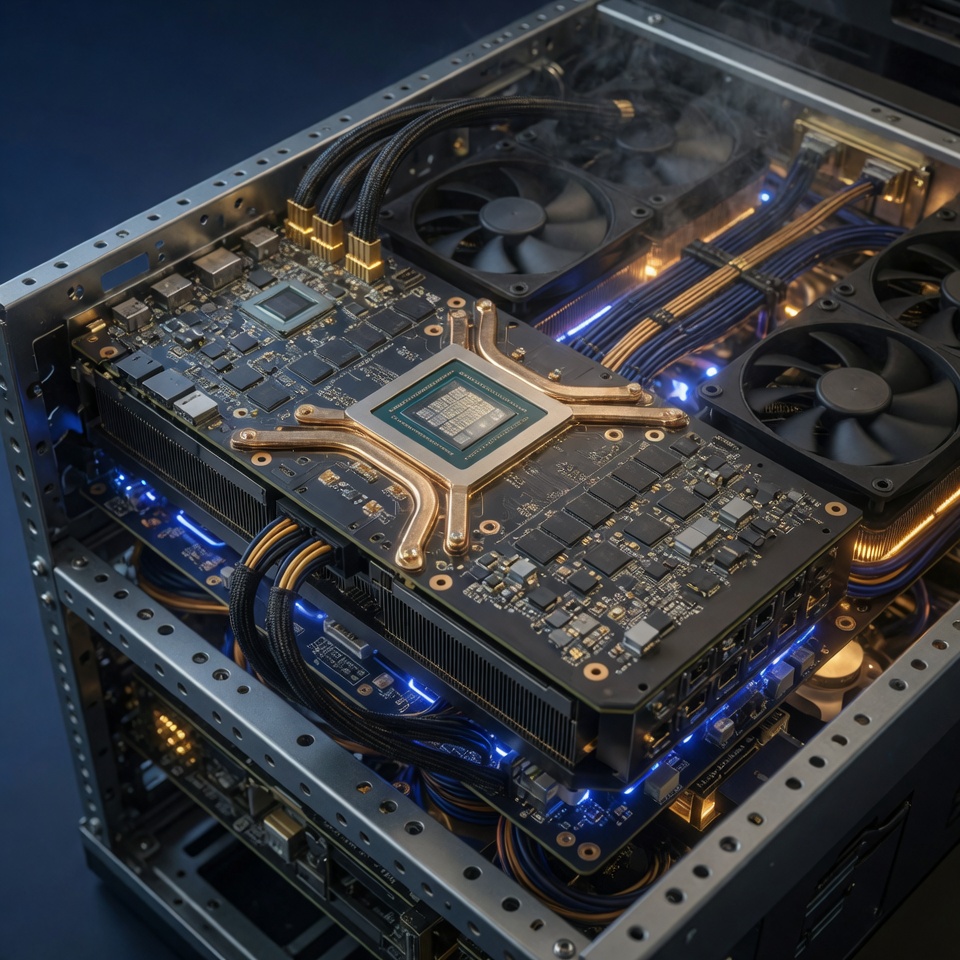
While the idea of an accelerator is abstract, its most common form is concrete. GPU accelerator cards slot into servers, draw heavy power, and link to one another so many can work as one. This is the physical shape of the hardware that speeds up nearly all large-scale AI today.
Built for scale
Trillion
Parameter scale NVIDIA built the Blackwell GPU platform to train and run, according to NVIDIA.
Source: NVIDIA Newsroom, March 2024
4 to 5x
Annual growth in training compute for frontier models since 2010, according to Epoch AI.
Source: Epoch AI, May 2024
Common kinds of AI accelerators
GPUs
The most widely used accelerator, flexible enough for both training and inference at large scale.
Purpose-built AI chips
Chips designed only for AI math, trading flexibility for efficiency on specific tasks.
Inference-focused chips
Hardware tuned to run finished models quickly and cheaply for many users at once.
On-device accelerators
Small accelerators in phones and laptops that run lightweight AI features close to the user.
Why efficiency per watt is the real prize
Speed is only half of what an accelerator delivers. The other half is efficiency, measured as useful work per watt of electricity. Because AI runs at enormous scale, even small gains in efficiency translate into large savings in power and cooling across a whole data center.
This matters because power has become a real constraint on AI. Facilities are limited by how much electricity they can draw and how much heat they can remove. An accelerator that does more work per watt lets the same building support more AI, which is why each new generation focuses heavily on efficiency, not just raw speed.
It also explains why general purpose chips lost this race. They spend power on flexibility that AI does not use. An accelerator concentrates its energy budget on the math AI actually needs, so more of every watt turns into useful output.
Common misconceptions about accelerators
One misconception is that an accelerator is just a faster chip. It is really a specialized one. It is faster at AI math precisely because it is worse at general tasks, having traded flexibility for focused performance.
Another misconception is that any accelerator can replace a GPU. In practice, GPUs remain the most flexible and widely supported option, so most software is built for them. A narrowly focused chip may be efficient at one task but lack the ecosystem that makes GPUs easy to use across many workloads.
A third misconception is that the chip alone determines results. As with any AI hardware, an accelerator only delivers value when it is housed, powered, cooled, and operated well. Idle or poorly run accelerators waste most of their advantage.
A final misconception is that a faster accelerator always wins. Memory size, the links between chips, and software support often matter more in practice. An accelerator that fits the model, connects well to others, and is easy to program for usually beats a raw speed leader that is awkward to use at scale.
Why the GPU remains the center of gravity
Among accelerators, the GPU remains the most flexible and widely supported, which is why NVIDIA built the Blackwell platform around it as the core engine for large-scale AI. For most organizations, GPU capacity is what defines what they can build.
Golden Core Mining helps customers own managed NVIDIA GPU hardware while a professional team handles operations and connection to demand. To learn more, explore our AI GPU infrastructure service.
Owning hardware does not guarantee any outcome. Operational benefits are not guaranteed and depend on utilization, uptime, demand, costs, hardware performance, and market conditions.
References and data
- NVIDIA Blackwell Platform Arrives to Power a New Era of Computing. NVIDIA Newsroom. March 2024.
- Training compute of frontier AI models grows by 4 to 5x per year. Epoch AI. May 2024.
Common questions about AI accelerators
Yes. The GPU is the most common AI accelerator. It was built for parallel math, which is exactly what AI needs, so it became the standard hardware for both training and running models.
A CPU is general purpose and spends much of its design on tasks AI does not need, which makes it slow and power hungry for AI math. An accelerator focuses on the specific operations AI uses, delivering far more useful work per chip and per watt.
No. GPUs are flexible and widely used, while some chips are built only for specific AI tasks like inference. They share the goal of speeding up AI but make different trade-offs between flexibility and efficiency.
Because AI runs at enormous scale, and power and cooling are real limits in data centers. An accelerator that does more work per watt lets the same building support more AI, so each new generation focuses heavily on efficiency, not only raw speed.
It can for narrow tasks, but GPUs remain the most flexible and widely supported option, and most AI software is built for them. A focused chip may be efficient at one job yet lack the ecosystem that makes GPUs easy to use across many workloads.
Increasingly, yes. Many devices include small on-device accelerators that run lightweight AI features close to the user. They follow the same idea as data center accelerators, just at a much smaller scale and power budget.
Talk with us about AI infrastructure ownership
Share your name, phone, email, and which managed device tier interests you. We will reach out with a clear walkthrough. No pressure.
Request received
Thank you. We will contact you at the phone number or email you provided.
Want to own the hardware that accelerates AI?
Talk through what owning managed NVIDIA GPU hardware would look like, with no pressure and straight answers.
Operational benefits are not guaranteed and depend on utilization, uptime, demand, costs, hardware performance, and market conditions.