Article on GPU availability
Why new GPUs sell out
The newest AI GPUs are often spoken for before they ship. Here is how allocation and pre-orders work, and why that leaves little for everyone else.
Key takeaways
- New AI GPUs are often allocated to large, committed buyers before they reach the open market.
- Pre-orders and long-term commitments let big buyers reserve supply far in advance.
- NVIDIA introduced the Blackwell platform for trillion-parameter scale AI, and demand for each new generation arrives immediately.
- Allocation favors the organized, which shapes who gets the latest hardware first.
Why the newest GPUs are spoken for early
When a new generation of AI GPU launches, much of the early supply is not sold first come, first served. It is allocated. Manufacturers and their partners distribute limited early production to large customers who placed orders well in advance and committed to buy at scale.
By the time a new chip is announced, a big share of the first batches is already assigned. That is why headlines about a hot new GPU are often followed within days by news that it is sold out. The demand was locked in before the public launch, so there was never a moment when open supply was abundant.
This is a rational response to scarcity, not a trick. When a producer can sell every unit it makes for the next year, it prefers buyers who commit early, purchase in volume, and can deploy the hardware reliably. Those customers reduce the producer's risk, so they get priority.
It is a different model than the launch-day rush people know from consumer electronics. There is no real shelf to clear, because most of the supply never reaches a shelf. The sale happened in private agreements months earlier, and the public announcement is closer to a status update than the opening of a store.
Three mechanisms that drain supply early
Pre-orders
Large buyers reserve hardware months ahead, often before final specifications are public, to guarantee a place in line.
Long-term commitments
Multi-year purchase agreements give manufacturers certainty and give big buyers priority access to scarce early units.
Allocation by scale
When supply is limited, producers favor customers who buy in volume and operate hardware reliably, leaving less for smaller buyers.
Why demand arrives instantly
1 trillion+
Parameter scale the NVIDIA Blackwell platform is built to train and run, according to NVIDIA.
Source: NVIDIA Newsroom, March 2024
4 to 5x
Annual growth in training compute for frontier AI models since 2010, according to Epoch AI.
Source: Epoch AI, May 2024
Where allocated hardware is headed
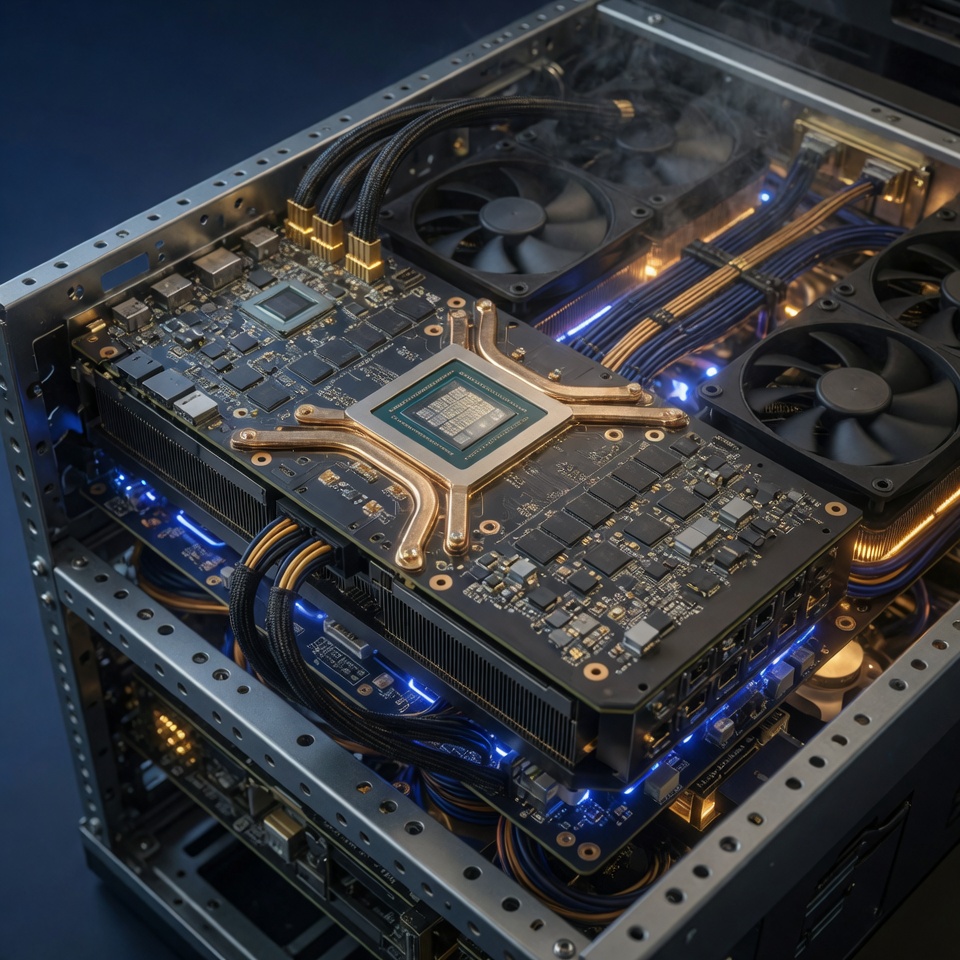
The accelerators that sell out are largely headed straight into clusters like the one shown here, assembled by buyers who reserved them long ago. By the time a launch is public, much of the supply is already on its way to racks rather than waiting on a shelf.
Each new generation has buyers waiting
New hardware does not have to build up an audience. NVIDIA introduced the Blackwell platform for trillion-parameter scale AI training and inference, and the buyers who need that capability were ready before it shipped. When the most capable chip is also the scarcest, the rush is immediate.
Epoch AI finds training compute for frontier models has grown 4 to 5 times per year since 2010. Demand that compounds that fast means every new generation is wanted the moment it appears, which is exactly when supply is tightest. There is no quiet introductory period during which casual buyers can pick one up.
What a sold-out launch leaves for everyone else
When the first batches are spoken for, smaller buyers face a choice between waiting for later production runs or paying a premium in the secondary market. Both options have drawbacks. Waiting can mean months of delay while the technology keeps moving, and secondary supply often carries higher prices and less certainty about condition or support.
This dynamic also shapes the kind of hardware that reaches the open market. The newest, most capable units tend to be the most heavily allocated, so what trickles out to general buyers is often a generation behind. For anyone who wants current capability, that gap between launch and general availability is the real obstacle, not the sticker price alone.
What a sold-out launch really tells you
A launch that sells out in minutes is easy to read as pure hype, but it usually signals something more durable: demand that was committed long before the public ever saw a price. When buyers reserve capacity a year ahead, a fast sellout is just the visible moment when that pre-committed demand becomes public.
It also signals confidence in the next wave of workloads. NVIDIA introduced the Blackwell platform for trillion-parameter scale AI, and buyers reserve that kind of hardware because they already have models and services that need it. The sellout reflects planned use, not impulse buying.
For everyone watching from outside, the lesson is about timing. The window to secure current hardware on ordinary terms is often gone before a launch is even announced, which is why planning ahead matters far more than reacting quickly on launch day.
How to get access without the front-of-line advantage
Most individuals cannot pre-order at the scale that secures early allocation. The practical alternative is to work with an operator that sources hardware professionally and lets you own it. The managed ownership model means a team handles procurement and operations while you hold the physical hardware, drawing on relationships and volume that a single buyer rarely has.
That arrangement does not jump the queue by magic. It simply pools the scale and expertise that allocation tends to reward, so that an individual owner is not negotiating alone against the largest buyers in the world.
Our service on managed GPU compute explains how that sourcing and operation works. It does not promise any particular result. Owning hardware does not guarantee any outcome. Operational benefits are not guaranteed and depend on utilization, uptime, demand, costs, hardware performance, and market conditions.
References and data
- NVIDIA Blackwell Platform Arrives to Power a New Era of Computing. NVIDIA Newsroom. March 2024.
- Training compute of frontier AI models grows by 4 to 5x per year. Epoch AI. May 2024.
Common questions about GPU availability
Much of the early supply is allocated to large buyers through pre-orders and long-term commitments before public launch. By the time a chip is announced, a big share of the first batches is already reserved.
Buyers who commit early, purchase at scale, and operate hardware reliably tend to receive priority allocation. That favors large, organized customers over smaller or one-off buyers.
When a producer can sell every unit for a year ahead, it prefers buyers who commit early, buy in volume, and deploy reliably, because they reduce its risk. Allocation is a rational response to scarcity rather than a trick.
Rarely for the newest hardware. Demand for each generation arrives immediately because buyers are waiting before it ships, so there is no quiet introductory window when casual buyers can simply purchase one.
Working with an operator that sources hardware professionally is one route. In the managed ownership model, the operator handles procurement and running the hardware while you own the physical machine, though outcomes are never guaranteed.
Talk with us about AI infrastructure ownership
Share your name, phone, email, and which managed device tier interests you. We will reach out with a clear walkthrough. No pressure.
Request received
Thank you. We will contact you at the phone number or email you provided.
Want access without winning the pre-order race?
Talk through what owning managed NVIDIA GPU hardware would look like, sourced and operated by professionals.
Operational benefits are not guaranteed and depend on utilization, uptime, demand, costs, hardware performance, and market conditions.