Infrastructure Explainer
What GPU compute infrastructure is
GPU compute infrastructure is more than a chip. It is hardware, operations, and demand working together. Golden Core Mining builds and runs that full stack for hardware you own.
A complete, operated infrastructure stack around NVIDIA hardware you own. Operational benefits are not guaranteed.
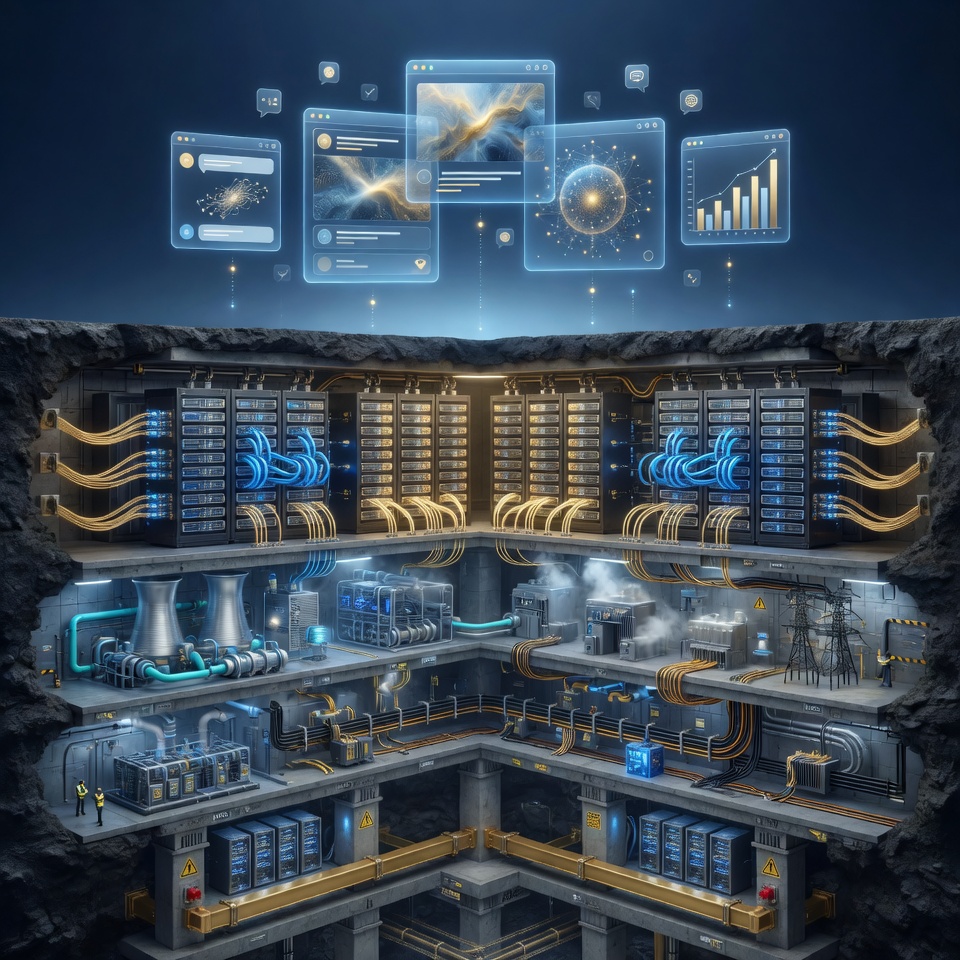
GPU compute infrastructure, defined
GPU compute infrastructure is the complete system that turns raw GPU hardware into useful AI compute. People often picture a single graphics card, but a card alone does nothing. It needs servers around it, networking to move data, power to run, cooling to stay healthy, and a connection to the workloads that need it.
A useful way to think about it is in three layers. The hardware layer is the physical equipment. The operational layer keeps that equipment running well. The demand layer is the AI work the hardware actually serves. Strong infrastructure means all three layers are handled properly, not just the hardware.
Most of the cost, complexity, and risk in AI compute lives outside the chip itself. Understanding the three layers is the fastest way to see why owning a GPU and running one productively are very different things.
The hardware layer
The physical equipment that does the computing.
NVIDIA GPUs
The parallel processors that perform the heavy math behind AI training and inference.
Servers
The systems that host the GPUs, with the CPUs, memory, and boards that feed them.
Networking
High-bandwidth links that move large datasets and connect machines together.
Storage
Fast storage so data is ready when the GPUs need it, avoiding idle time.
Power delivery
Clean, redundant power sized for sustained high-draw compute.
Cooling
Thermal systems that remove the heat dense GPU hardware produces.
The operational layer
The work that keeps the hardware useful, day after day.
Hosting
A professional U.S. data center environment built for high-density compute.
Uptime support
Redundancy and rapid response so the hardware stays available.
Monitoring
Continuous tracking of temperature, utilization, and health signals.
Maintenance
Diagnostics, part replacement, and vendor coordination to limit downtime.
What the stack looks like at scale
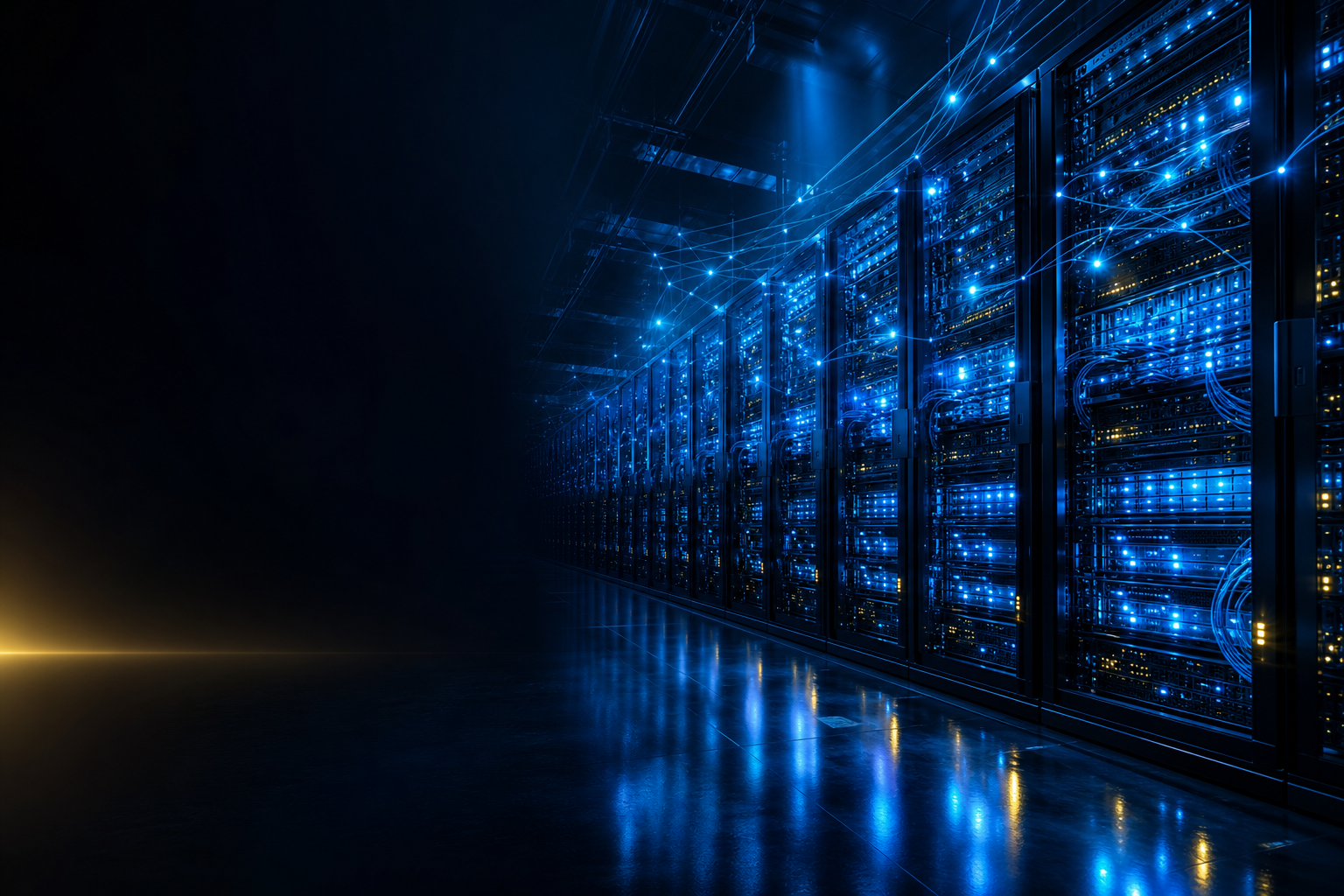
Seen at scale, GPU compute infrastructure is less a product and more a coordinated system. Racks of servers, overhead networking, power distribution, and cooling all have to line up so that every accelerator stays fed with data and kept within temperature. When one layer is weak, the others cannot make up for it.
The demand layer
The AI workloads the infrastructure exists to serve.
AI training
Building models from large datasets, which is compute heavy and sustained.
AI inference
Running trained models to answer requests, which scales with usage.
Rendering
Graphics and simulation workloads that also rely on parallel compute.
Machine learning
Experimentation, fine tuning, and research across many fields.
Why home GPU hosting is usually not competitive
It is tempting to think you can build this at home. In practice, the operational layer is what makes it hard. Residential power and cooling are not designed for sustained high-density compute, home internet is not built for large AI workloads, and someone has to monitor and maintain the machine around the clock.
Professional infrastructure exists because these problems are real. A data center solves power, cooling, connectivity, security, and uptime as a service, which is difficult and expensive to replicate in a house.
There is also the human cost. A serious training or inference machine needs attention at all hours, and a single thermal or power fault can take it offline. Outsourcing that burden is often the whole point of managed infrastructure.
Owning the hardware is the easy part. Operating it well is the hard part, and that is the part Golden Core Mining handles.
How managed ownership brings the layers together
- You own the hardware layer. You hold a real, physical NVIDIA-powered machine documented in your name.
- We run the operational layer. Golden Core Mining provides hosting, power, cooling, networking, monitoring, and maintenance.
- We connect the demand layer. We link the hardware to AI compute provider networks so it can serve real workloads.
- You receive reporting. You pay a fixed monthly management fee and follow utilization through periodic reports.
How fast the infrastructure layer is growing
176 TWh
U.S. data center electricity use in 2023, up from about 58 TWh in 2014, according to Lawrence Berkeley National Laboratory.
Source: Lawrence Berkeley National Laboratory, December 2024
~945 TWh
Projected global data centre electricity use by 2030, more than double 2024, according to the IEA.
Source: International Energy Agency (IEA), April 2025
What to weigh before owning a piece of the stack
When people first look at GPU compute infrastructure, they tend to focus on the chip and underestimate everything around it. A useful habit is to ask where each layer will come from. Who supplies the power, who designs the cooling, who watches the hardware at three in the morning, and who connects it to real workloads. If any of those answers is unclear, the hardware will struggle no matter how capable it is.
Cost is the other consideration that surprises owners. The up-front hardware is visible, but the ongoing operating costs of power, cooling, connectivity, and maintenance are continuous and real. A managed model folds the operations work into a fixed monthly fee, so the budgeting is predictable, but the costs themselves never disappear. Being honest about them is part of making a sound decision.
Finally, think in terms of time horizon. Infrastructure is a long-lived asset, and demand for any given hardware generation shifts as newer hardware arrives. Owning a piece of the stack fits people who want a lasting position rather than a quick task, and who are comfortable that any operational benefit depends on conditions that no one fully controls.
What is not guaranteed
Utilization
Hardware only produces benefits when it is running paid workloads.
Demand
AI compute demand changes with the market and is outside anyone's control.
Operating costs
Power, cooling, and maintenance are ongoing and real.
Hardware lifecycle
Performance and demand for a given generation change over time.
Operational benefits are not guaranteed and depend on utilization, uptime, demand, costs, hardware performance, and market conditions.
GPU compute infrastructure questions
It is the complete system that turns GPU hardware into useful AI compute, across three layers: the hardware itself, the operations that keep it running, and the AI demand it serves. All three have to work together.
No. A GPU needs servers, networking, storage, power, cooling, and a connection to real workloads. The infrastructure around the chip is what makes it useful.
The operational layer is the obstacle. Homes are not built for sustained high-density power, cooling, connectivity, and around-the-clock uptime. Data centers solve those problems as a service.
We build and operate the full infrastructure stack around NVIDIA hardware you own, including hosting, power, cooling, networking, monitoring, maintenance, and AI provider access in U.S. data centers.
All three matter, but the operational layer is usually the deciding factor. Strong hardware with weak operations sits idle or overheats, while well-run operations keep capable hardware serving demand.
Yes. You hold the physical machine documented in your name. Golden Core Mining operates the surrounding infrastructure, but the asset itself remains yours, and outcomes are never guaranteed.
Talk with us about AI infrastructure ownership
Share your name, phone, email, and which managed device tier interests you. We will reach out with a clear walkthrough. No pressure.
Request received
Thank you. We will contact you at the phone number or email you provided.
Want the infrastructure without building it?
Talk through how the hardware, operations, and demand layers come together on hardware you own.
Operational benefits are not guaranteed and depend on utilization, uptime, demand, costs, hardware performance, and market conditions.