Cluster Infrastructure
AI GPU cluster infrastructure for high-demand compute
The largest AI workloads do not run on one GPU. They run on clusters of GPUs working together. Golden Core Mining operates the infrastructure that makes clusters reliable.
Cluster-grade infrastructure and operations for owned hardware. Operational benefits are not guaranteed.
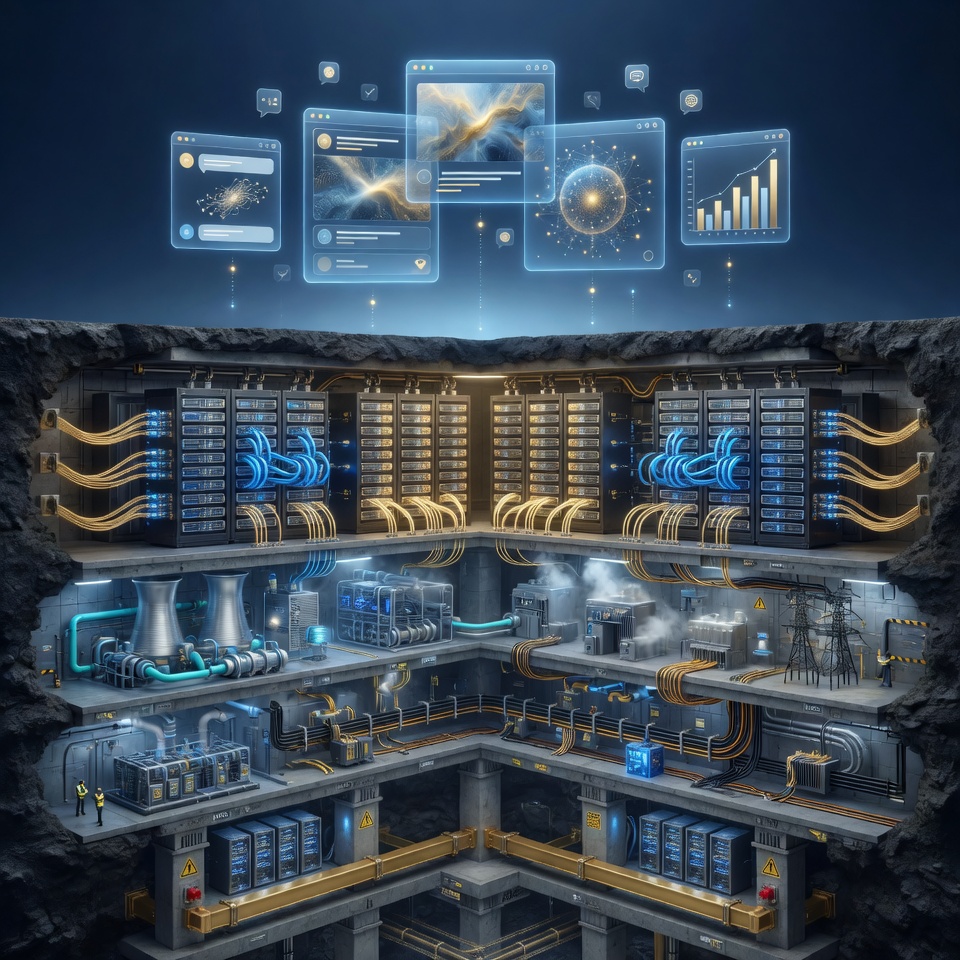
What a GPU cluster is
A GPU cluster is a group of GPU servers connected together so they can work on a problem as one larger machine. Instead of a single GPU handling a workload, many GPUs split the work and coordinate through high-speed networking.
Clusters exist because the biggest AI workloads are too large for any single device. Combining many GPUs lets them tackle models and datasets that would otherwise be impossible to run.
The defining feature of a cluster is coordination. The GPUs are only as useful as their ability to share data quickly and stay in step, which is why a cluster is a system rather than just a pile of hardware.
Why AI workloads need clusters
Training large models requires far more memory and compute than one GPU provides. Clusters spread the work, but only if the GPUs can share data fast enough to stay coordinated. The networking between GPUs becomes as important as the GPUs themselves.
This is why cluster infrastructure is a discipline of its own. Getting many GPUs to behave like one efficient machine is an engineering and operations challenge that does not appear when you run a single device.
Scale also changes the cost of failure. In a single machine, a fault stops one workload. In a cluster, a single weak node can stall a job spread across dozens of GPUs, wasting the compute they have already spent. That is why cluster operations put so much weight on fast monitoring and maintenance, because protecting one node is really about protecting the whole coordinated system.
Networking, cooling, power, monitoring, and maintenance
Networking
High-bandwidth, low-latency interconnect so GPUs share data without waiting.
Cooling
Dense clusters concentrate heat, so cooling must be serious and consistent.
Power
Many GPUs at full load demand significant, stable, redundant power.
Monitoring
Cluster health depends on watching every node continuously.
Maintenance
A failed node can stall a job, so fast maintenance protects the whole cluster.
Orchestration
Coordinating workloads across nodes keeps utilization high.
What a cluster looks like in operation

At scale, a cluster is rows of GPU servers tied together by fast networking, all kept cool and powered as a single unit. The engineering that makes them act as one is invisible from the outside, but it is exactly where the difficulty and the value live.
Why professional data center operation matters
Clusters amplify both the rewards and the risks. When a cluster runs well, it can serve the most demanding AI workloads. When operations are weak, a single problem can take many GPUs offline at once.
Golden Core Mining provides the managed hardware ownership model with professional operations behind it. You can own NVIDIA hardware that runs within cluster-grade infrastructure, without operating the cluster yourself. What that hardware produces still depends on demand and utilization, and is never guaranteed.
For an owner, the appeal is access to a class of infrastructure that would be impractical to build alone. Cluster-grade networking, cooling, and power are expensive and complex to run, and they need people watching them around the clock. Owning a machine that sits inside that environment lets you hold the asset while a dedicated team carries the operational difficulty.
A cluster is only as strong as its operations. That is the part we run.
How owned hardware joins cluster-grade infrastructure
- Acquire. You purchase NVIDIA-powered hardware documented in your name.
- Deploy. We install it within cluster-grade infrastructure in a U.S. data center.
- Operate. We run networking, cooling, power, monitoring, and maintenance across nodes.
- Serve demand. The hardware connects to AI provider networks to serve workloads when demand exists.
What is not guaranteed
Demand
Cluster-scale demand depends on the AI market.
Utilization
Hardware produces benefits only when serving workloads.
Uptime
Node failures and maintenance reduce active hours.
Costs
Power, cooling, and networking are ongoing costs.
Operational benefits are not guaranteed and depend on utilization, uptime, demand, costs, hardware performance, and market conditions.
AI GPU cluster questions
It is a group of GPU servers connected by high-speed networking so they can work on a single large problem together, acting like one bigger machine.
The largest models need more memory and compute than one GPU can provide, so the work is split across many GPUs that must share data quickly to stay coordinated.
Networking, cooling, power, and fast maintenance all have to be excellent at once. A single weak point can take many GPUs offline, which is why professional operations matter.
GPUs in a cluster constantly share data, so if the interconnect is slow they sit idle waiting on each other. High-bandwidth, low-latency networking is what lets many GPUs behave like one efficient machine.
Yes. With managed ownership you hold NVIDIA hardware that runs within cluster-grade infrastructure operated by Golden Core Mining, without managing the cluster yourself. Outcomes are never guaranteed.
A failed node can stall a job, so fast monitoring and maintenance are essential to protect the rest of the cluster. Even with strong operations, uptime can never be fully guaranteed.
Talk with us about AI infrastructure ownership
Share your name, phone, email, and which managed device tier interests you. We will reach out with a clear walkthrough. No pressure.
Request received
Thank you. We will contact you at the phone number or email you provided.
Own hardware that runs in serious infrastructure.
Talk through NVIDIA hardware ownership backed by professional cluster operations.
Operational benefits are not guaranteed and depend on utilization, uptime, demand, costs, hardware performance, and market conditions.