Cooling and Power
GPU cooling and power for AI hardware
Heat and power are where AI hardware lives or dies. Golden Core Mining provides the industrial cooling and redundant power that keep NVIDIA GPUs healthy.
Industrial cooling and redundant power for hardware you own. Operational benefits are not guaranteed.
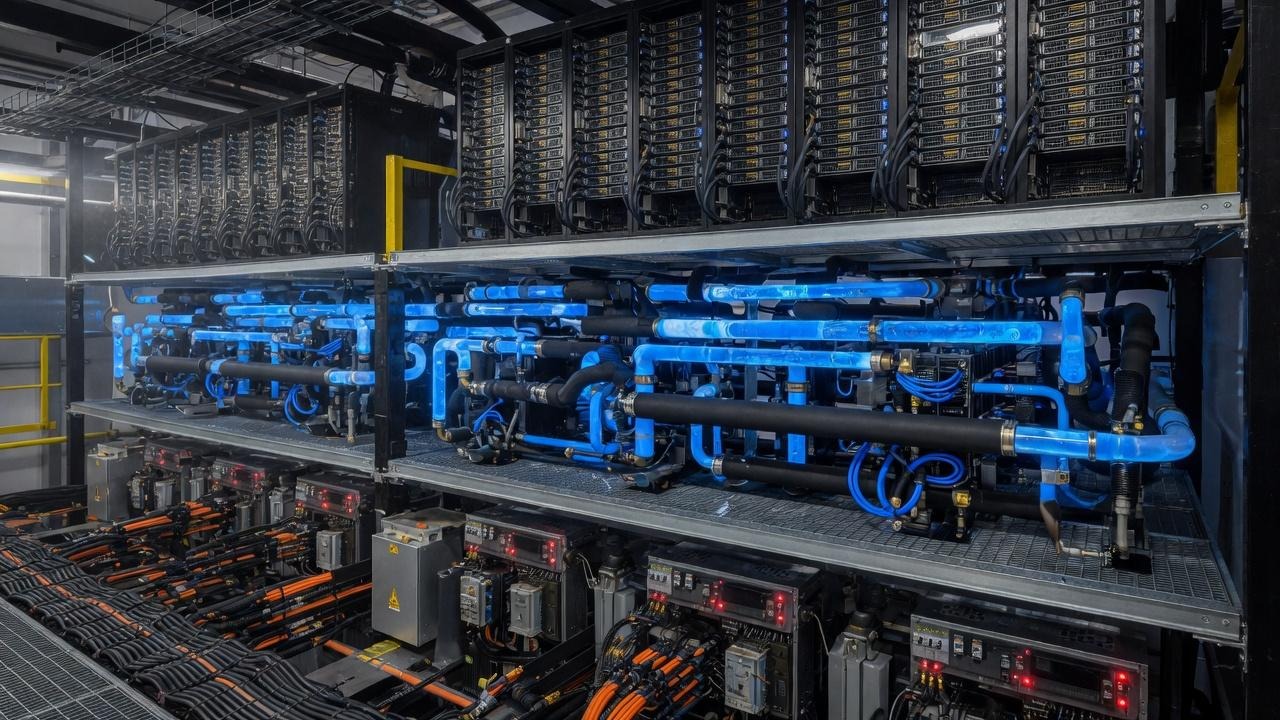
Why cooling decides hardware health
High-density GPUs produce a large amount of heat when running AI workloads. A single modern accelerator can draw hundreds of watts, and a full server packs several of them into a small space. If that heat is not removed efficiently, the hardware throttles to protect itself, runs slower, and ages faster. Sustained high temperatures are one of the fastest ways to shorten the working life of expensive equipment.
Heat is not a one-time event either. AI training and inference can run continuously for days or weeks, so cooling has to perform under constant load rather than in short bursts. The difference between a machine that runs cool and one that runs hot is the difference between hardware that stays healthy for years and hardware that degrades early.
Professional cooling keeps GPUs inside safe operating ranges even under sustained pressure. This is one of the clearest reasons AI hardware belongs in a purpose-built data center rather than a home or office, where airflow, ambient temperature, and heat removal were never designed for this kind of density.
Why power has to be clean and redundant
AI hardware draws heavy, continuous power. It needs a supply that is both high in capacity and stable in quality, with backup paths so that a single fault does not stop everything at once. Residential and ordinary commercial power is simply not designed for this kind of sustained industrial load.
Power quality matters as much as power quantity. Voltage sags, surges, and brief interruptions all put electrical stress on components and can trigger faults or data loss. Clean, conditioned power protects the hardware from that stress, while redundancy means that if one feed or unit fails, another is ready to carry the load.
This is why data centers invest in uninterruptible power systems, backup generation, and multiple distribution paths. The aim is not perfection, which no facility can promise, but a level of resilience that keeps hardware running through the events that would take a home setup offline.
Cooling and power are not glamorous, but they are the foundation everything else depends on.
Air cooling, liquid cooling, and what dense GPUs need
There is no single way to cool AI hardware, and the right method depends on how much heat the equipment produces in how small a space. Air cooling moves heat away with carefully engineered airflow, hot aisles, cold aisles, and high-capacity fans that pull warm air out before it can build up. It is well understood and works for a wide range of densities, but it has limits once the heat per rack climbs into the range that modern accelerators reach.
Liquid cooling carries heat away with coolant that moves much more thermal energy than air can for the same volume. Approaches range from rear-door heat exchangers to direct-to-chip cold plates that sit on the hottest components. For the densest GPU configurations, liquid cooling is increasingly the practical choice, because air alone struggles to keep pace with the heat that trillion-parameter-scale training and heavy inference generate.
In practice, a serious facility matches the method to the hardware and the load rather than forcing one approach everywhere. The goal is the same in every case, which is to hold the GPUs inside safe operating ranges hour after hour. Choosing and running the right cooling is exactly the kind of specialized work that is hard to reproduce at home and straightforward inside a purpose-built data center.
What Golden Core Mining manages
Thermal management
Cooling systems built to remove the heat of dense GPU hardware under continuous load.
Redundant power
High-capacity, conditioned, and backed-up power for continuous operation.
Environmental monitoring
Continuous tracking of temperature, humidity, and power conditions.
Capacity planning
Power and cooling sized for sustained AI compute, not short bursts.
What industrial cooling and power look like
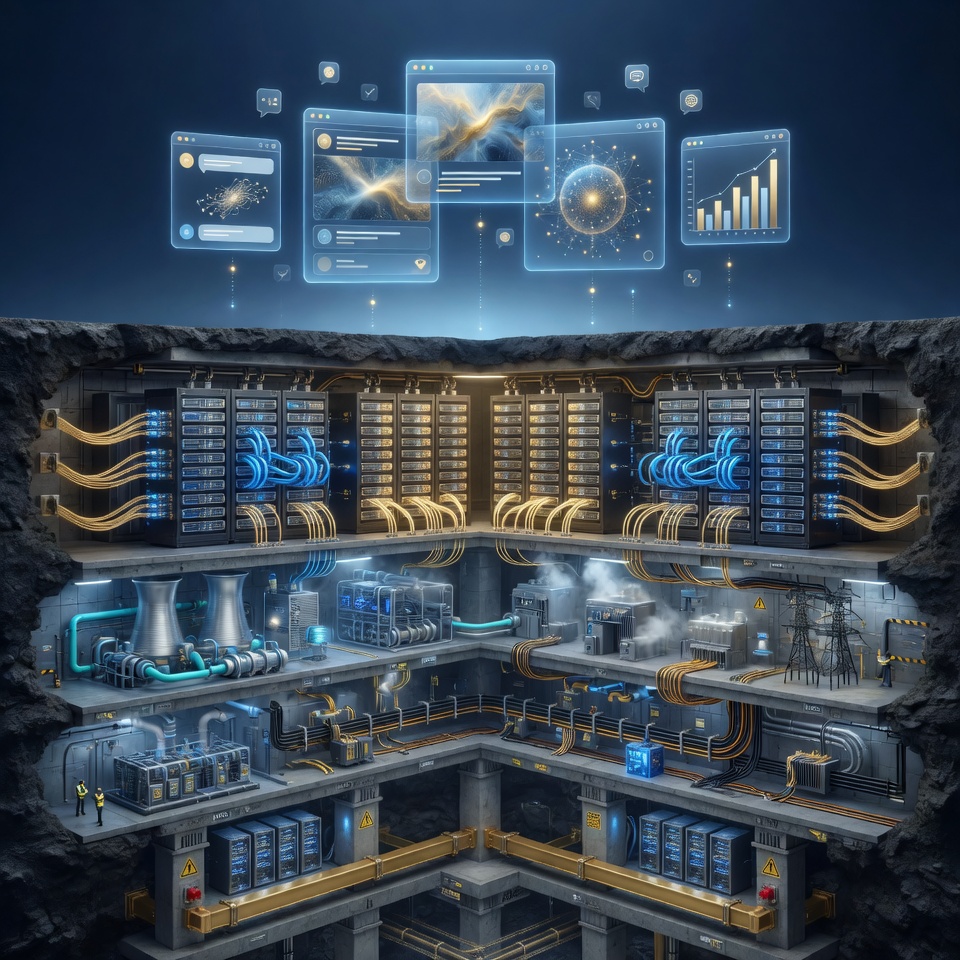
Most people picture the GPU when they think of AI hardware, but the systems around it do the quiet work of keeping it alive. Cooling loops, air handling, power distribution, and backup units fill far more space than the servers and run every hour of every day.
Building and operating this layer is expensive and specialized, which is exactly why pooling it inside a professional facility makes more sense than recreating it at home.
Why power has become the defining constraint
176 TWh
U.S. data center electricity use in 2023, up from about 58 TWh in 2014, according to Lawrence Berkeley National Laboratory.
Source: Lawrence Berkeley National Laboratory, December 2024
about 30%
Projected yearly growth in electricity use by accelerated AI servers, according to the IEA.
Source: International Energy Agency (IEA), April 2025
100 MW+
Power drawn by the largest frontier training runs today, according to Epoch AI.
Source: Epoch AI, 2025
How cooling and power reach your hardware
- Size. We plan power and cooling capacity for the specific GPU hardware and its expected sustained load.
- Deliver. Conditioned, redundant power and engineered cooling are connected to the hardware in the facility.
- Monitor. Temperature and power conditions are tracked continuously so problems are caught early.
- Maintain. Cooling and electrical systems are serviced on schedule to keep performance steady over time.
How cooling and power connect to managed GPU ownership
Cooling and power are the reason managed ownership exists as a model. You can own a powerful NVIDIA machine, but it only stays healthy if it lives somewhere that can keep it cool and supply it with stable power around the clock. That environment is hard and costly to build alone, so Golden Core Mining provides it for the hardware you own.
Pooling cooling and power inside a professional facility also spreads the cost and complexity of these systems across many machines, which is something an individual owner cannot do on their own. The same engineered cooling loops, backup generators, and uninterruptible power systems serve the whole room, so each machine benefits from infrastructure that would be impractical to justify for a single server at home.
It is worth being clear about what this does and does not promise. Good cooling and redundant power keep hardware ready and reduce avoidable downtime, but they cannot create AI compute demand, guarantee that the machine is always busy, or remove every possible interruption. Operational benefits depend on real-world utilization, costs, and market conditions, not on the cooling system alone.
What is not guaranteed
Demand
Good cooling and power keep hardware ready, not busy.
Utilization
Benefits require running workloads.
Uptime
Redundancy reduces, but cannot remove, every interruption.
Costs
Electricity and cooling are ongoing operating costs.
Operational benefits are not guaranteed and depend on utilization, uptime, demand, costs, hardware performance, and market conditions.
Cooling and power questions
GPUs produce a lot of heat under load. Without efficient cooling, they throttle, run slower, and age faster. Sustained high temperatures shorten hardware life, so consistent thermal management is essential for hardware meant to run continuously.
AI hardware draws heavy continuous power. Redundant, backed-up power keeps it running through outages and protects it from the electrical stress that causes faults. A single feed without backup is a single point of failure.
Air cooling moves heat away with engineered airflow, while liquid cooling carries heat away with coolant and is better suited to very dense, high-power hardware. The right approach depends on the hardware and the facility, and both are designed to hold GPUs in safe temperature ranges.
Generally no. Homes are not built for industrial cooling or sustained high-draw power, which is why AI hardware belongs in a professional data center designed for continuous load.
No. Cooling and power keep hardware healthy and available, but operational benefits depend on utilization, demand, costs, and market conditions. Nothing about cooling guarantees an outcome.
Power and cooling are ongoing operating costs that are part of running the hardware. They are accounted for in operations, and they continue whether or not the hardware is fully utilized, which is one reason outcomes are never guaranteed.
Talk with us about AI infrastructure ownership
Share your name, phone, email, and which managed device tier interests you. We will reach out with a clear walkthrough. No pressure.
Request received
Thank you. We will contact you at the phone number or email you provided.
Keep your hardware cool, powered, and healthy.
Talk through cooling, power, and operations for NVIDIA hardware you own.
Operational benefits are not guaranteed and depend on utilization, uptime, demand, costs, hardware performance, and market conditions.