Article on AI infrastructure
How GPU clusters work
A single GPU is powerful, but the largest AI models need thousands working as one. Here is how GPU clusters are built and why they matter.
Key takeaways
- A GPU cluster links many GPUs together so they can work on one large problem as a team.
- The biggest AI models are too large for a single GPU, so clusters are a necessity, not a luxury.
- Fast connections between GPUs are as important as the GPUs themselves.
- A cluster is more than a pile of chips; it needs careful design, power, cooling, and operation.
What a GPU cluster is
A GPU cluster is a group of many GPUs connected together so they can work on the same task at the same time. Instead of one chip handling a problem alone, dozens, hundreds, or thousands of GPUs split the work and combine their results.
This is essential because the largest AI models are simply too big to fit on a single GPU. Their parameters and the data flowing through them exceed what one chip can hold, so the work must be spread across many GPUs that act as one large machine.
Think of a cluster as a single computer made of many smaller ones. To the people running a training job, it can look like one enormous machine, even though under the surface the work is carefully divided and coordinated across a whole room of hardware.
How the GPUs coordinate
In a cluster, a model is divided into pieces that different GPUs handle, and the data is split as well. As they work, the GPUs constantly exchange results so the overall calculation stays consistent. This sharing happens millions of times during a single training run.
Because of all that communication, the connections between GPUs matter as much as the GPUs themselves. If the network linking them is slow, the GPUs spend their time waiting instead of computing, and the cluster's real power drops far below its potential.
Coordinating thousands of GPUs is also a software challenge. The work has to be divided so that no single GPU becomes a bottleneck, and the results have to be merged correctly every step of the way. Getting this balance right is part of what separates a fast cluster from a slow one.
Reliability adds another layer. With so many chips running for so long, the odds that at least one will fault during a job are real. Well-run clusters are designed to detect a problem and recover without losing the entire run, since a single failure that goes unhandled can waste days of work across the whole machine.
What a cluster looks like from the inside

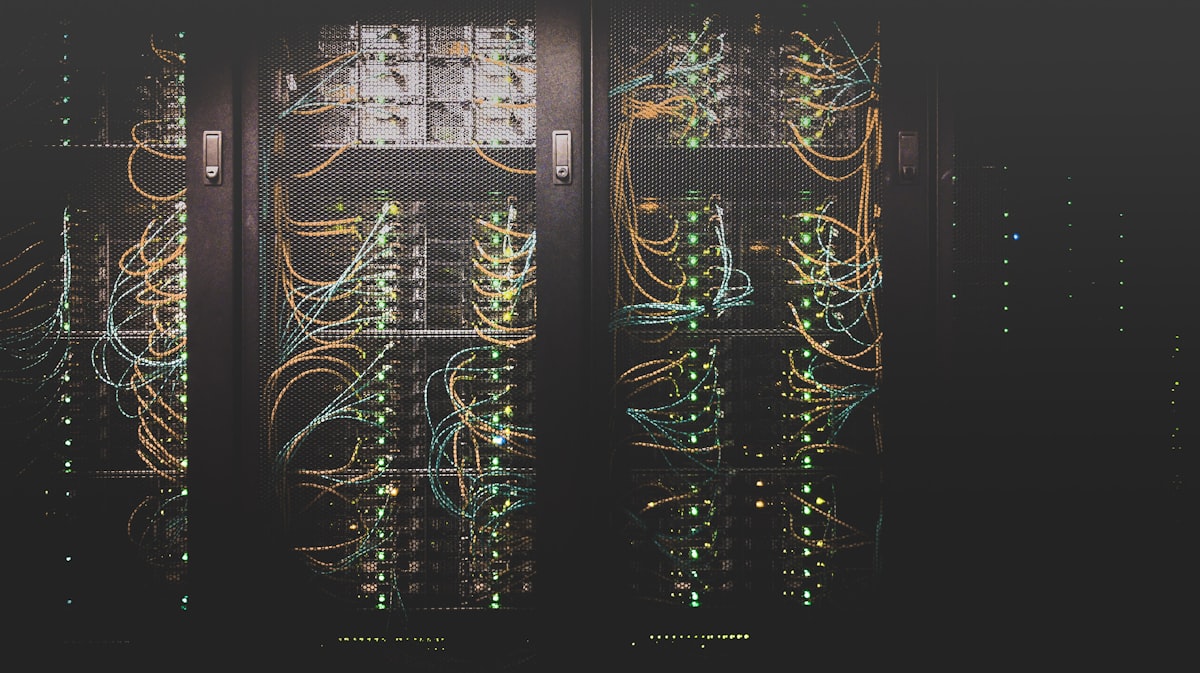
A cutaway view shows why a cluster is more than its chips. Around the racks of GPUs sit the power distribution, cooling, and dense networking that keep the whole system running in step. Remove any one of those, and the GPUs cannot work together effectively, no matter how powerful each one is.
What goes into a working cluster
- The GPUs. Many accelerators provide the raw parallel compute that does the actual math.
- The interconnect. High-speed links let GPUs share results fast enough to stay in step with each other.
- Power and cooling. Dense racks draw heavy power and produce heat that must be removed continuously.
- Operations. Monitoring and maintenance keep the cluster running and minimize wasted, idle capacity.
Why a cluster is more than a pile of chips
Buying many GPUs does not automatically create a useful cluster. They must be physically housed, networked with care, supplied with reliable power, and cooled around the clock. A weakness in any of these areas drags down the whole system.
This is why operating a cluster is a discipline of its own. The hardware sets the ceiling on what is possible, but careful design and steady operation decide how much of that ceiling you actually reach.
It is also why two clusters with identical GPUs can perform very differently. The one that is networked well, cooled properly, and kept busy will deliver far more useful work than one that is poorly designed or frequently idle.
How a big job is divided across GPUs
Splitting the data
Different GPUs process different slices of the dataset, then combine what they learned into one model.
Splitting the model
When a model is too large for one GPU, its layers are spread across several so each holds a piece.
Keeping in sync
GPUs exchange results constantly so every copy of the model stays consistent as it learns.
Avoiding bottlenecks
Work is balanced so no single GPU or link becomes the slow point that holds back the rest.
Common misconceptions about clusters
One misconception is that more GPUs always means proportionally more speed. In reality, as a cluster grows, the cost of keeping GPUs in sync grows too. Without strong networking and careful design, adding chips can deliver diminishing returns.
Another misconception is that a cluster is just hardware you switch on. Running one is an ongoing operational effort involving monitoring, maintenance, cooling, and balancing workloads. The cluster's real value depends on how well that work is done day after day.
A third misconception is that any group of connected GPUs is a cluster. A true cluster is engineered so the GPUs act as one coordinated machine. Loosely connected hardware without fast links and careful operation behaves more like separate computers than a single system.
A final misconception is that once a cluster is built, the hard part is over. In reality the ongoing work of monitoring, cooling, maintaining, and balancing workloads is constant. A cluster is less like a finished product and more like a facility that has to be run carefully every day to keep delivering its potential.
From understanding clusters to having access
Because clusters are demanding to build and run, getting access to well-operated cluster capacity is a meaningful advantage. The difference between a good cluster and a struggling one comes down to design and operation.
Golden Core Mining helps customers own managed NVIDIA GPU hardware that sits inside professionally run cluster infrastructure. To learn more, explore our AI GPU cluster infrastructure service.
Owning hardware does not guarantee any outcome. Operational benefits are not guaranteed and depend on utilization, uptime, demand, costs, hardware performance, and market conditions.
Common questions about GPU clusters
The largest models are too big to fit in a single GPU's memory, and training them on one chip would take far too long. A cluster splits the work across many GPUs so they finish in a practical amount of time.
High-speed networking links the GPUs so they can share results constantly. This interconnect is critical, because if it is slow the GPUs end up waiting on each other instead of computing.
No. A cluster also needs fast networking, reliable power, continuous cooling, and careful operation. Without those, a group of GPUs cannot work together effectively no matter how powerful each one is.
Not exactly. As a cluster grows, the cost of keeping GPUs in sync grows too. With strong networking and careful design the gains can be close to proportional, but poor design leads to diminishing returns as chips are added.
The data is split so different GPUs process different slices, and large models are split so their layers sit on different GPUs. The GPUs then exchange results constantly to keep every copy of the model consistent as it learns.
Because operation and design matter as much as the chips. A cluster that is networked well, cooled properly, and kept busy delivers far more useful work than one that is poorly designed or frequently idle, even with the same GPUs.
Talk with us about AI infrastructure ownership
Share your name, phone, email, and which managed device tier interests you. We will reach out with a clear walkthrough. No pressure.
Request received
Thank you. We will contact you at the phone number or email you provided.
Want a position inside real cluster infrastructure?
Talk through what owning managed NVIDIA GPU hardware would look like, with no pressure and straight answers.
Operational benefits are not guaranteed and depend on utilization, uptime, demand, costs, hardware performance, and market conditions.