Article on home hosting cost
The total cost of owning a GPU at home
A GPU rig looks like a single purchase, but the real bill arrives every month after. Here is the full cost of running AI hardware at home, broken down line by line, and how it compares to managed hosting.
Key takeaways
- The purchase price of a GPU rig is a small share of what it actually costs to run.
- Power and cooling are continuous costs that scale with the hours the machine runs.
- Downtime and your own labor are real costs that rarely show up in a budget.
- A managed data center turns scattered hidden costs into one predictable operational line.
The purchase price is just the entry fee
When people price a home GPU rig, they look at the cost of the card and the box around it. That number feels like the whole decision, but it is closer to a deposit. AI workloads run the hardware hard and often, and almost every meaningful cost shows up after the machine is plugged in, not before.
The reason is simple. The purchase is a one-time event, while running the machine is a continuous one. A rig that serves sustained AI compute is working most hours of most days, and every one of those hours costs something in power, cooling, and wear that the sticker price never mentioned.
To understand what ownership really costs, you have to count the things that recur. Power, cooling, downtime, and your own time do not appear on the receipt, yet together they usually decide whether running hardware at home makes sense at all.
The costs that do not fit on the receipt
Continuous power
A high-draw machine running day and night becomes one of the largest items on a home electricity bill, and that draw never pauses while the work does.
Cooling overhead
Removing constant heat means more air conditioning and higher bills, or hardware that ages faster under sustained high temperatures.
Downtime
A home setup has no redundancy, so a tripped breaker or failed fan is lost work with nothing standing by to take over.
Your labor
Patching, monitoring, and repairs are hours of your time, and that time has a real value even when no invoice names it.
Where the costs go in a facility
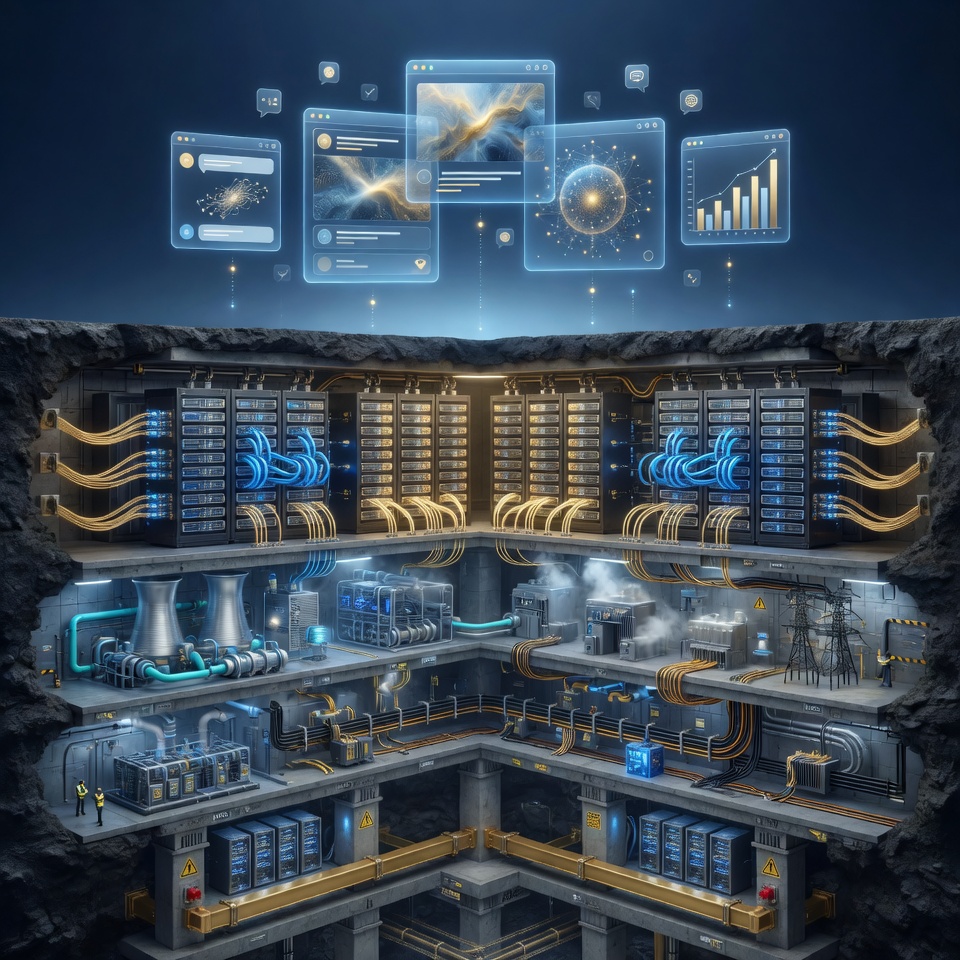
A cutaway of a real facility shows why the cost math is different inside one. Power distribution, cooling plants, and redundant systems are built once and shared across many machines, so the heavy fixed costs are spread rather than carried alone.
A home rig has to absorb scaled-down versions of all of these costs by itself, with consumer equipment that is less efficient. That structural difference, not the hardware, is what makes the total cost of home ownership so much higher than it first appears.
Why power dominates the total
176 TWh
U.S. data center electricity use in 2023, up from about 58 TWh in 2014, according to Lawrence Berkeley National Laboratory.
Source: Lawrence Berkeley National Laboratory, December 2024
~30%/yr
Growth in electricity use by accelerated AI servers, according to the IEA.
Source: International Energy Agency (IEA), April 2025
Where the money goes: home rig vs managed hosting
| Cost area | Home rig | Managed data center |
|---|---|---|
| Power | Retail residential rates on an always-on load | Bought at facility scale and shared across the building |
| Cooling | Home air conditioning pushed beyond its design | Industrial cooling built for high-density hardware |
| Downtime | No redundancy, so every fault is lost work | Redundant power and network reduce and shorten outages |
| Maintenance | Your nights and weekends | Handled by an on-site operations team |
| Predictability | Variable bills that spike with usage | One operational fee that covers the work |
Why a data center changes the total
A professional facility buys power and cooling at scale, spreads fixed costs across many machines, and runs operations as a service. The per-machine economics of serious AI compute are simply different inside a building designed for it than in a spare room that was not.
The national energy figures above explain why power is the line that matters most. Electricity is the dominant running cost of AI hardware, and a facility purchases it at industrial scale and uses it more efficiently than any home can. Cooling, networking, and maintenance follow the same pattern, getting cheaper per machine as they are shared.
That is the reasoning behind managed ownership. You still own the physical hardware, but the scattered hidden costs of running it move to a team and a facility built to absorb them, turning many unpredictable bills into one operational line.
The line item budgets always forget
Almost every home-rig budget leaves out the most personal cost: your own time. The hours spent applying updates, chasing a crash, swapping a failed fan, or simply checking that the machine is still healthy are hours with real value, and they recur for as long as you own the hardware.
This cost is easy to ignore because it never arrives as a bill, but it is often the one that wears people down first. A rig that demands an evening here and a disrupted night there gradually turns ownership into an obligation. Putting an honest number on your time is the surest way to see the total cost clearly, and it usually tips the comparison toward a managed model where that time is someone else's job.
Counting the whole bill
Before you buy a rig, total everything: the hardware, the power, the cooling, the downtime, and your own hours. Then set that next to managed ownership, where a single operational fee covers the work and the hardware lives in a facility built for it.
Seen as a total rather than a sticker price, the comparison is rarely about which option is cheaper to buy. It is about which one is genuinely sustainable to run for the years you intend to own the hardware.
Owning hardware in any form carries cost and risk. Operational benefits are not guaranteed and depend on utilization, uptime, demand, costs, hardware performance, and market conditions.
References and data
- 2024 United States Data Center Energy Usage Report. Lawrence Berkeley National Laboratory. December 2024.
- Energy and AI. International Energy Agency (IEA). April 2025.
Questions about the cost of GPU ownership
Continuous power and cooling, followed by downtime and your own time. These recur every month the machine runs and usually outweigh the original purchase price over the life of the hardware.
For sustained AI workloads it often changes the math. Facilities buy power and cooling at scale, share fixed costs, and reduce downtime with redundancy, which lowers the per-machine operational cost compared with a single home setup.
Because an AI machine at sustained load draws heavy, constant electricity that never pauses. National figures from Lawrence Berkeley National Laboratory show data center electricity use rising sharply, and at home that same draw lands on a retail residential bill.
Yes. The hours spent on updates, monitoring, and repairs have real value and recur for as long as you own the hardware. Leaving them out makes a home rig look cheaper than it actually is to run.
Add the hardware price, a full year of continuous power at your local rate, extra cooling, a realistic allowance for downtime, and the value of your upkeep hours. Then compare that total to a single managed operational fee.
Yes. Managed ownership lets you own the physical NVIDIA-powered machine while a professional team operates it in a U.S. facility, so the recurring costs become one operational line instead of many. Outcomes are never guaranteed.
Talk with us about AI infrastructure ownership
Share your name, phone, email, and which managed device tier interests you. We will reach out with a clear walkthrough. No pressure.
Request received
Thank you. We will contact you at the phone number or email you provided.
See the real cost before you buy a rig.
Talk through managed ownership where one operational fee covers power, cooling, and upkeep.
Operational benefits are not guaranteed and depend on utilization, uptime, demand, costs, hardware performance, and market conditions.