Article on timing
Why the AI compute window matters
Big infrastructure shifts tend to have windows: periods where building and positioning are easier than they will be later. The AI compute buildout looks like one, and this is a plain-language look at why timing matters without pretending anyone can predict the future.

Key takeaways
- Infrastructure cycles tend to reward early, deliberate positioning more than late, reactive moves.
- AI compute demand and the power behind it are still growing quickly, according to multiple independent sources.
- A window is about positioning during a buildout, not a prediction that any specific outcome will happen.
- Owning managed hardware is one way to hold a position without taking on data center operations yourself.
Infrastructure cycles open windows
Railroads, electricity, and the internet all had buildout phases when the underlying infrastructure was first being created. During those phases, positioning was different from the mature, settled years that followed. Early infrastructure tends to be scarce, heavily used, and sought after, because supply has not yet caught up with the demand the new technology unlocks. The people and companies who understood what was being built, and acted while it was still being built, were in a very different position from those who waited until the picture was obvious to everyone.
A window, in this sense, is not magic and it is not luck. It is the simple gap in time between when a technology proves it is useful and when the infrastructure to serve that technology becomes abundant. While that gap is open, the hardware and the facilities are the bottleneck, and a bottleneck is exactly where positioning matters most. Once the gap closes, the advantage of being early fades, because capacity is everywhere and the scarcity that defined the early years is gone.
The AI compute buildout has the same shape. The GPUs, the power, and the data centers behind modern AI are being built right now, in real time, and the demand for them is still climbing faster than the supply. That combination is the signature of a buildout window rather than a mature market, and it is why the question of timing is worth taking seriously instead of waving away.
The growth is still accelerating
The signals here are not subtle. According to the IEA, data centre electricity demand grew about 17 percent in 2025, and electricity use by AI-focused data centres surged about 50 percent that year. Power is the clearest proxy we have for how much compute is being deployed, because every additional GPU has to be fed and cooled, so a sharp rise in electricity use means a sharp rise in real, installed capacity being put to work rather than a rise in talk or speculation.
Adoption is moving just as fast on the demand side. The Stanford AI Index found that generative AI reached mainstream use faster than the internet or the personal computer did, and that global corporate AI investment more than doubled in 2025. When a tool spreads that quickly and the money behind it doubles, the pressure on the underlying compute does not ease, it intensifies, and that pressure lands on physical hardware that takes years rather than weeks to bring online.
Fast adoption sitting on top of heavy, physical infrastructure needs is exactly the pattern that defines a buildout window. The usefulness has been proven, the spending is real, and the hardware to serve all of it is still being installed. None of that tells you how any single decision will turn out, but together it tells you why the moment is unusual.
What the numbers say about the window
~50%
Surge in AI-focused data centre electricity use in 2025, according to the IEA.
Source: International Energy Agency (IEA), 2025
~17%
Growth in overall data centre electricity demand in 2025, according to the IEA.
Source: International Energy Agency (IEA), 2025
3 years
Time for generative AI to reach mainstream use, faster than the internet, according to the Stanford AI Index.
Source: Stanford Institute for Human-Centered AI (HAI), April 2026
What a buildout window looks like
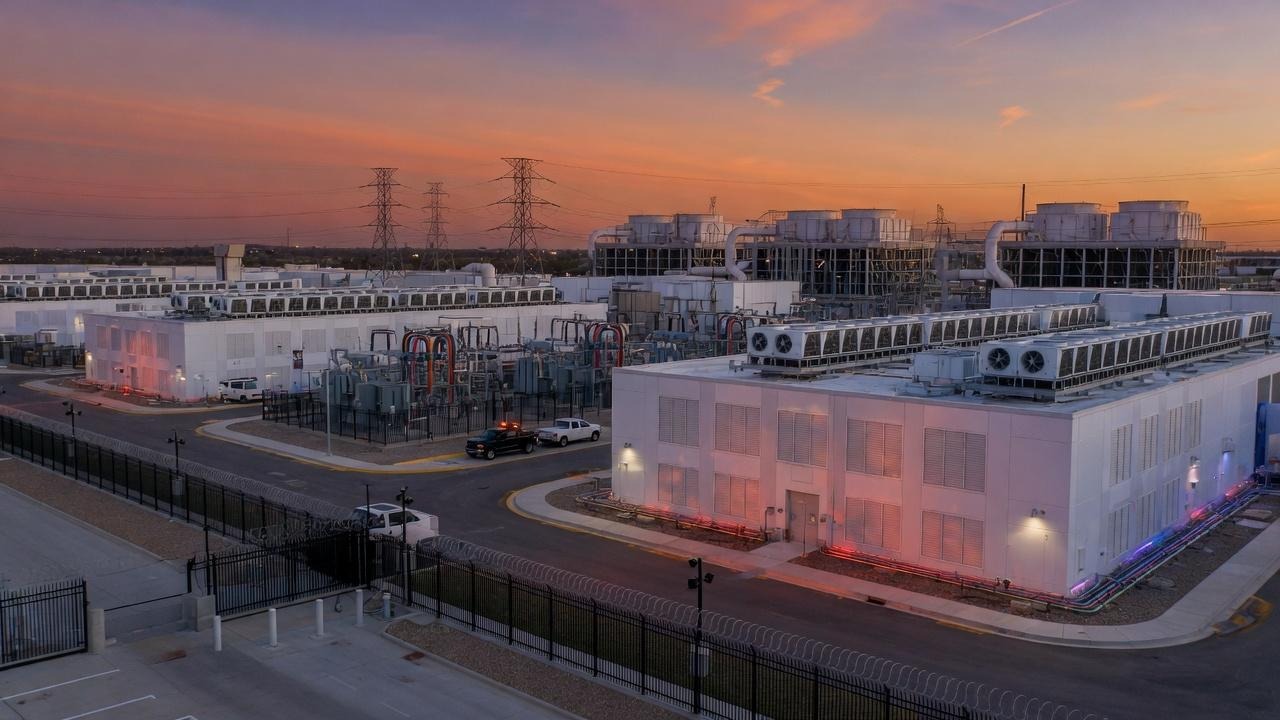
It helps to picture what the window actually is. It is not a stock chart or a headline. It is physical capacity being poured into the ground: campuses, power substations, cooling plants, and racks of GPUs that did not exist a few years ago. Every one of these takes time to build, which is part of why supply lags demand during the window.
Because the bottleneck is physical, it cannot be solved instantly with more spending. Transformers, switchgear, and grid connections have lead times measured in months and years, and a data center is only finished when the slowest of those pieces arrives. That is what gives a buildout window its shape and its duration, and it is why early, deliberate positioning tends to matter during the phase when the concrete is still being poured.
What makes the AI compute window unusual
Physical bottleneck
The limit is not ideas, it is hardware, power, and cooling. Those take years to build, so demand stays ahead of supply for an extended stretch rather than clearing in a single season.
Broad demand
AI is being adopted across many industries at once rather than in a single niche, which keeps pressure on compute from many directions at the same time and makes the trend harder to stall.
Concentrated supply
Cutting-edge GPUs and the facilities to run them are produced by a small number of players, so capacity does not appear overnight even when money is plentiful and willing.
Ownership is now possible
For the first time, individuals can own a piece of this infrastructure through managed hardware, rather than only watching large companies build it from the outside.
A window is not a countdown clock
It is easy to hear the word window and picture a door slamming shut on a fixed date, after which the chance is gone forever. That is the wrong mental model, and it tends to push people into rushed, fear-driven decisions. A buildout window is not a deadline, it is a phase, and phases open and close gradually as supply slowly catches up with demand over a span of years.
The more useful way to read it is as a description of conditions, not a stopwatch. Right now the conditions are unusual: scarcity is high, capacity is still being installed, and the technology has already proven it is useful. Those conditions will not last forever, but they also will not vanish in a week, so there is no honest case for panic. The case is simply that the conditions today are different from the conditions a mature market will eventually settle into.
Holding the idea this way protects you from two mistakes at once. It keeps you from dismissing the moment as hype, and it keeps you from treating it as a now-or-never gamble. Neither extreme is accurate, and neither leads to a good decision.
A window is an opportunity to think, not a promise
Calling something a window is not a prediction that prices go up or that any outcome is assured. Windows can be misjudged, supply can catch up faster than expected, and infrastructure carries real costs and real risks that do not disappear because a trend is strong. Anyone who tells you a buildout assures a result is selling certainty that does not exist, and that kind of certainty is the clearest warning sign to walk away.
The honest takeaway is narrower and more useful. A buildout phase is a good time to understand your options clearly, to learn how the pieces fit together, and to decide deliberately on your own timeline rather than reacting to hype. Timing here means positioning thoughtfully while the picture is still forming, not gambling on a forecast that nobody can actually make.
Held that way, the idea of a window is a tool for clear thinking. It tells you why now is worth paying attention, without pretending to tell you how any individual choice will turn out. That is a smaller claim than the hype, and it is a far more trustworthy one.
If you decide to take a position
One practical way to hold a position during a buildout is owning managed hardware. In that model you own a physical NVIDIA-powered machine, and a professional team operates it inside a U.S. data center, handling the power, cooling, connectivity, and upkeep that make sustained compute possible. It is a way to participate in the infrastructure being built without becoming a data center operator yourself, which is a job very few people actually want.
That is the connection to managed GPU ownership: it turns the abstract idea of a compute window into a concrete, owned asset that is professionally run. Golden Core Mining exists to make that path workable for people who want the hardware without the operations, and it is worth talking through before deciding anything.
Whatever you decide, decide it for your own reasons and on your own schedule. Nothing here is a sure thing. Operational benefits are not guaranteed and depend on utilization, uptime, demand, costs, hardware performance, and market conditions.
References and data
- Key Questions on Energy and AI. International Energy Agency (IEA). 2025.
- The 2026 AI Index Report. Stanford Institute for Human-Centered AI (HAI). April 2026.
Questions about the compute window
It is the buildout phase of a major technology, when the underlying infrastructure is still being created and tends to be scarce and heavily used. Railroads, electricity, and the internet all had one. During the window, the hardware is the bottleneck, which is why positioning matters more then than later.
No. A window is an opportunity to think and position deliberately, not a promise. Infrastructure carries real costs and risks, supply can catch up, and operational benefits are never guaranteed. Anyone promising a certain result is overstating what is knowable.
The clearest signals are physical. According to the IEA, AI-focused data centre electricity use surged about 50 percent in 2025 and overall data centre demand grew about 17 percent, while the Stanford AI Index found adoption and corporate AI investment still climbing. That is demand outrunning installed supply, which is what an open window looks like.
Because the limit is physical hardware, power, and cooling that take years to build. While supply lags demand, early and deliberate positioning is meaningfully different from waiting until capacity is abundant and the picture is obvious to everyone.
It can, but not in a way anyone can quantify with certainty. Waiting trades the harder conditions of a buildout for the easier conditions of a mature market, and by then the early positioning advantage has usually faded. The point is to decide deliberately rather than by default.
One option is managed hardware ownership. You own a physical NVIDIA-powered machine while a professional team runs it in a data center, so you can participate in the infrastructure being built without operating it yourself. Outcomes are never guaranteed.
Talk with us about AI infrastructure ownership
Share your name, phone, email, and which managed device tier interests you. We will reach out with a clear walkthrough. No pressure.
Request received
Thank you. We will contact you at the phone number or email you provided.
Want to understand the buildout window?
Talk through managed GPU ownership and decide on your own timeline, with no pressure and straight answers.
Operational benefits are not guaranteed and depend on utilization, uptime, demand, costs, hardware performance, and market conditions.