Article on AI and energy
AI energy demand explained
AI uses far more electricity per task than most software. Here is why AI workloads are so power hungry, explained in plain language with real data.

Key takeaways
- AI workloads run dense parallel math on power-hungry chips, so they draw far more electricity per task than ordinary software.
- Data centres used about 415 TWh worldwide in 2024, and electricity use by accelerated AI servers has been growing about 30 percent per year, according to the IEA.
- Both training and inference add to demand, and adoption keeps multiplying the number of requests served.
- Power and cooling have become as important as the chips themselves.
Why AI is so power hungry
Most everyday software is light on the hardware. It waits for a click, does a small amount of work, and waits again. AI is different. Training and running modern models means doing dense parallel math across thousands of chips at once, often for hours or continuously. That sustained, heavy workload draws a lot of electricity, and it does so without the long idle gaps that keep ordinary computing cheap.
The chips themselves are built for throughput, not idle efficiency. A modern AI accelerator can pull hundreds of watts on its own, and a single rack of them can demand as much power as many homes. Multiply that across a data center full of racks and the energy footprint grows quickly.
There is also the matter of utilization. To be worth their cost, AI accelerators are kept busy as much as possible. A chip that runs near full load most of the time uses far more energy over a year than an office computer that sits mostly idle, even if their peak ratings looked similar on paper.
What the data shows
415 TWh
Electricity used by data centres worldwide in 2024, about 1.5 percent of global supply, according to the IEA.
Source: International Energy Agency (IEA), April 2025
30%
Approximate yearly growth in electricity use by accelerated AI servers, according to the IEA.
Source: International Energy Agency (IEA), April 2025
945 TWh
Projected global data centre electricity by 2030, more than double the 2024 level, according to the IEA.
Source: International Energy Agency (IEA), April 2025
Two sources of demand: training and inference
AI energy demand comes from two stages. Training is the one-time, intensive process of building a model, which can run for weeks across huge clusters drawing tens of megawatts. Inference is what happens every time someone uses the finished model, and it happens millions of times a day across the world.
Training gets the headlines because the runs are so large and visible, but inference is the steady, growing drain. As AI features get added to search, productivity tools, and apps, each new user adds to the total. That is why the International Energy Agency expects accelerated AI server electricity to keep climbing about 30 percent per year.
The balance between the two is shifting. Early in the AI boom, training dominated the conversation. As models reach hundreds of millions of users, the cumulative cost of serving them now rivals or exceeds the cost of building them, which changes how operators plan their power.
The cooling that comes with the power
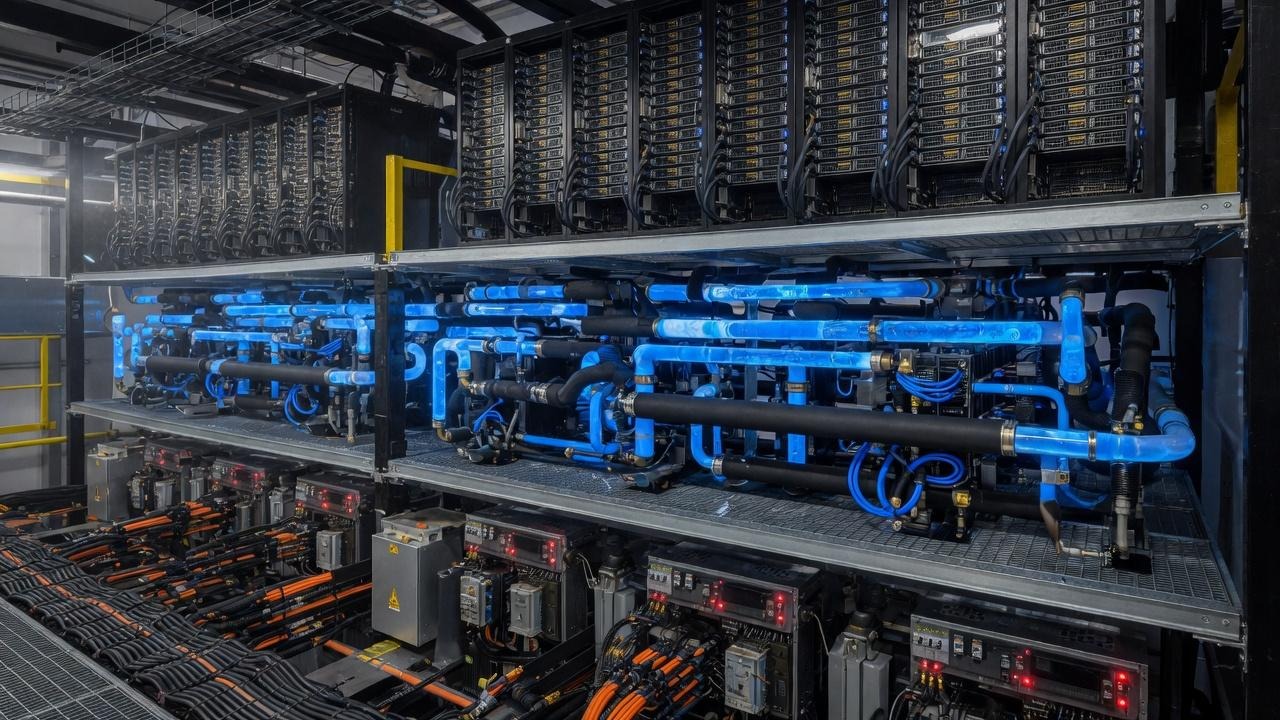
Every watt a chip draws becomes heat that has to be carried away, and that cooling draws power of its own. The shift to liquid cooling, shown here, is a direct response to how much heat dense AI hardware produces. Power and cooling are not separate problems but two sides of the same energy story.
The hidden cost of keeping chips cool
Power consumed by chips does not vanish. It turns into heat, and that heat has to be removed or the hardware throttles and fails. Cooling can add a meaningful share on top of the electricity the chips draw, which is why efficient data centers work hard to keep that overhead low.
This is one reason AI workloads concentrate in purpose-built facilities. Reliable power and serious cooling are not optional extras. They decide whether expensive hardware can run safely at full capacity, and they shape how much of each electricity bill goes to useful work rather than waste.
The scale of the heat is easy to underestimate. A dense rack of AI accelerators can produce more heat in a small footprint than a room full of conventional servers, and that heat has to be removed continuously, not just during busy spells. Designing for that steady thermal load is a large part of why AI facilities look and cost so different from ordinary data centers.
What keeps multiplying AI energy demand
Bigger models
Each new generation of model tends to use more compute per task, so the energy cost of state-of-the-art capability keeps rising even as efficiency improves.
Wider adoption
More users mean more inference calls. As AI is built into mainstream tools, the number of requests served grows steadily across the day and night.
Autonomous agents
AI agents make many model calls per task rather than one, so as they spread they multiply the number of inference calls behind everyday work.
Why efficiency gains do not lower total demand
It is tempting to assume that as chips and software get more efficient, AI energy demand will level off. In practice the opposite has happened. Each efficiency gain makes a given task cheaper to run, which tends to invite more tasks rather than fewer, so total energy use keeps climbing even as the cost per operation falls.
The IEA captures this in its projections. Despite steady efficiency improvements, it still expects global data centre electricity to more than double to around 945 TWh by 2030. Efficiency softens the slope of the curve, but it has not bent the line downward.
This pattern, where greater efficiency unlocks new uses instead of cutting consumption, is common in energy history. For AI it means power planning has to assume demand will keep rising, not that better hardware will quietly solve the problem on its own.
Why operations matter as much as ownership
Because AI hardware is so power hungry, running it well takes infrastructure and expertise. Owning a GPU machine is one thing. Keeping it powered, cooled, monitored, and busy is another. The managed ownership model splits those roles: you own the physical hardware, and a professional team operates it inside a data center built for the load.
The power-hungry nature of AI hardware is exactly why this division of labor exists. Securing reliable power, designing cooling for a heavy thermal load, and keeping utilization high are specialized jobs. Handing them to a dedicated team is a way to let the hardware run as it is meant to, rather than leaving an owner to wrestle with infrastructure problems alone.
Our service on managed GPU compute walks through how that operation runs day to day. It does not erase the underlying uncertainty of any infrastructure. Owning hardware does not guarantee any outcome. Operational benefits are not guaranteed and depend on utilization, uptime, demand, costs, hardware performance, and market conditions.
References and data
- Energy and AI. International Energy Agency (IEA). April 2025.
Common questions about AI energy demand
AI runs dense parallel math on specialized chips for sustained periods, often continuously. Those chips are built for throughput and draw hundreds of watts each, so AI workloads use far more electricity per task than typical software that mostly sits idle.
Training runs are individually huge, but inference is the steady and growing drain because finished models are used millions of times a day. As adoption rises, inference becomes a larger share of total AI energy demand.
The IEA reports that electricity use by accelerated AI servers has been growing about 30 percent per year, and it projects global data centre electricity to more than double to around 945 TWh by 2030.
Cooling adds a meaningful share on top of the power the chips draw, because every watt of compute becomes heat that must be removed. Efficient facilities work to keep that overhead low, which is one reason AI concentrates in purpose-built data centers.
Efficiency helps but has not offset demand. Models do more with the same chips over time, yet appetite for capability and the number of users both keep rising, so total energy demand continues to climb.
Talk with us about AI infrastructure ownership
Share your name, phone, email, and which managed device tier interests you. We will reach out with a clear walkthrough. No pressure.
Request received
Thank you. We will contact you at the phone number or email you provided.
Want hardware that is actually run well?
Talk through what owning managed NVIDIA GPU hardware would look like, with the power and cooling handled for you.
Operational benefits are not guaranteed and depend on utilization, uptime, demand, costs, hardware performance, and market conditions.