Article on timing
How infrastructure cycles work
Infrastructure does not arrive all at once. It is built in cycles, with predictable phases. Understanding those phases explains why timing matters during a buildout, without hype.
Key takeaways
- Infrastructure is built in cycles that move through demand, scarcity, buildout, and maturity.
- The scarce phase is when access is hardest to get and most contested.
- Buildout takes years because it needs land, power, and construction, not just chips.
- Knowing where a cycle sits helps you decide deliberately, but it never guarantees an outcome.
Why infrastructure arrives in cycles
Infrastructure rarely appears smoothly. It tends to move in cycles. A new use emerges, demand rises faster than anyone planned for, supply stays scarce while builders catch up, and eventually new capacity comes online and the pressure eases. Then a new layer of demand begins the pattern again. The cycle is not a theory imposed on the data. It is the natural consequence of physical capacity taking time to build while demand can spike almost overnight.
This shape is not unique to AI. It described railroads, electrical grids, and broadband networks long before it described GPUs. The common thread is that the useful application tends to arrive before the capacity to serve it is fully built, so demand and supply rarely move in step. The gap between them is where timing becomes a real consideration.
Understanding the cycle does not require predicting it. It only requires recognizing the phases and noticing which one a market appears to be in. That recognition is what turns a confusing, fast-moving situation into something you can reason about.
The four phases of a buildout cycle
- Demand emerges. A new use creates appetite for a resource faster than existing supply was designed to serve. Early on, few people grasp how steep the curve will be.
- Scarcity sets in. Demand outpaces supply. Access is contested, queues form, and buyers compete to secure capacity early. This is the phase where timing matters most.
- Buildout accelerates. Capital floods into new capacity. Land, power, and construction take years to convert into usable supply, so scarcity persists even as building ramps up.
- Maturity arrives. Supply catches up to demand, access eases, and pricing stabilizes until the next wave of demand begins the pattern again.
Where the AI compute cycle appears to sit
The current AI buildout shows the marks of the scarce and accelerating phases at once. The International Energy Agency projects data centre electricity demand to more than double to roughly 945 TWh by 2030, while capital pours into new facilities and AI-focused data centre electricity use surged about 50 percent in 2025. Demand is clearly outpacing the supply that exists today, even as construction ramps up.
No one can time a cycle precisely, and labeling a phase is always a judgment rather than a certainty. The framework does not tell you what prices will do or when maturity will arrive. What it offers is context. It explains why access is hard right now and why the buildout will take years to change that, regardless of how much capital is committed.
That context is more useful than a forecast, because it is grounded in the physical reality of how capacity gets built rather than in a guess about the market.
Signals of where the cycle sits
945 TWh
Projected data centre electricity demand by 2030, more than double the 2024 level, according to the IEA.
Source: International Energy Agency (IEA), April 2025
~50%
Surge in AI-focused data centre electricity use in 2025, according to the IEA.
Source: International Energy Agency (IEA), 2025
4 to 5x
Annual growth in training compute for frontier AI models since 2010, according to Epoch AI.
Source: Epoch AI, May 2024
What the buildout phase looks like
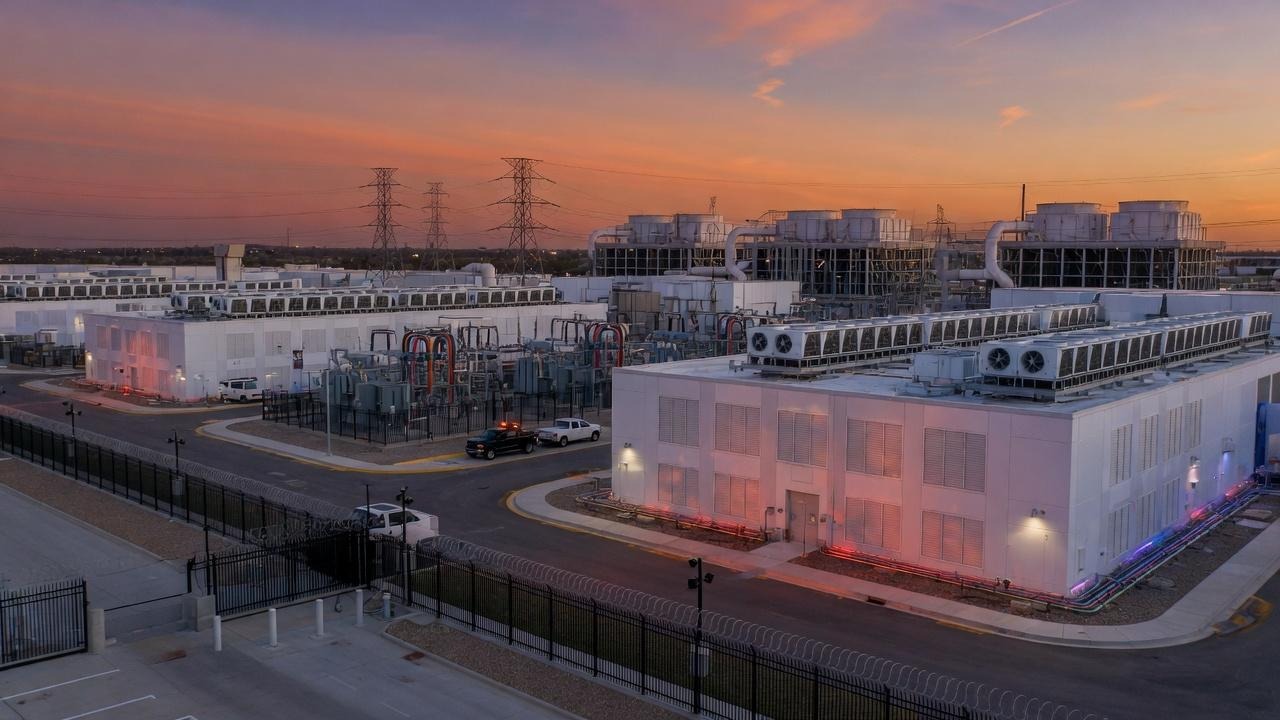
The buildout phase is where abstract capital turns into concrete, steel, and power connections. A campus like this represents years of land acquisition, permitting, and construction before it can run workloads.
Because that conversion is slow, scarcity tends to persist well into the buildout phase, which is exactly why timing remains a live question even as building accelerates.
Why the buildout phase takes years
The slow part of a cycle is not designing chips. It is everything physical around them. New data centers need land, grid connections, high-density power, and cooling systems, and each of those steps takes time, capital, and approvals. Grid interconnection queues alone can stretch for years in many regions. That is why supply cannot simply expand to meet a demand spike, no matter how much money is available.
Understanding this explains why timing matters during the scarce phase. The hardware is not the only constraint. The capacity to run it, the power, the cooling, the physical building, is just as real and just as slow to build. A cycle stays in its scarce phase for as long as those physical bottlenecks persist, which tends to be years rather than months.
The mistake of assuming you can time it perfectly
The biggest mistake people make with cycles is treating the framework as a precise clock. It is not. Cycles can only be labeled with confidence in hindsight, and anyone who claims to know exactly when a phase will turn is overstating what the model can do. The framework is a lens for understanding, not a tool for prediction.
The honest use of cycle thinking is modest. It helps you understand why access is contested now and why that is unlikely to change quickly, so you can decide deliberately rather than react to headlines. It does not tell you what to do, and it certainly does not guarantee any outcome from acting at a particular moment.
From understanding the cycle to taking a position
Knowing where a cycle sits can inform a decision, but it cannot make it for you. If you decide a position in AI compute fits your goals, one route is owning a physical NVIDIA machine that a professional team operates through the demanding phases of the cycle. Golden Core Mining is built around that model, and you can read how it works on our managed GPU compute page.
Decide on your own timeline. Reading a cycle is not the same as predicting it, and none of the benefits of owning hardware are guaranteed. Operational benefits depend on utilization, uptime, demand, costs, hardware performance, and market conditions, regardless of which phase a cycle is in.
References and data
- Energy and AI. International Energy Agency (IEA). April 2025.
- Key Questions on Energy and AI. International Energy Agency (IEA). 2025.
- Training compute of frontier AI models grows by 4 to 5x per year. Epoch AI. May 2024.
Questions about infrastructure cycles
It is the repeating pattern where a new use creates demand, supply stays scarce while builders catch up, capital accelerates a buildout, and eventually capacity matures and access eases. Railroads, electricity, and broadband all followed this shape before AI compute.
Demand emerges, scarcity sets in, buildout accelerates, and maturity arrives. The scarce phase is when access is hardest and timing matters most, and it tends to persist because physical capacity is slow to build.
It shows signs of the scarce and accelerating phases at once. The IEA projects data centre electricity demand to more than double by 2030 and reports AI-focused data centre electricity surged about 50 percent in 2025, while capital flows into new capacity. Labeling a phase is a judgment, not a certainty.
Because the slow part is physical, not digital. New facilities need land, permits, grid connections, high density power, and cooling, and each step takes years. Grid interconnection queues alone can stretch for years, so supply cannot expand quickly even with ample capital.
No. Cycles can only be labeled with confidence in hindsight. The framework offers context for deciding deliberately, but it does not predict prices, name exact turning points, or guarantee any outcome.
Talk with us about AI infrastructure ownership
Share your name, phone, email, and which managed device tier interests you. We will reach out with a clear walkthrough. No pressure.
Request received
Thank you. We will contact you at the phone number or email you provided.
Want to understand a position in the cycle?
Talk through what owning managed NVIDIA GPU hardware would look like, with no pressure and straight answers.
Operational benefits are not guaranteed and depend on utilization, uptime, demand, costs, hardware performance, and market conditions.