Article on timing
Why AI infrastructure is being built now
The AI buildout is not arbitrary. Demand, energy needs, and capital are converging at the same moment. Here is a plain, data-backed look at why it is accelerating now, without hype.

Key takeaways
- The buildout is accelerating because demand, energy, and capital are converging at once.
- AI-focused data centre electricity surged about 50 percent in 2025, according to the IEA.
- Building physical capacity takes years, so construction starts well ahead of expected demand.
- Knowing why the buildout is happening informs decisions, but it guarantees no outcome.
Three forces converging at once
The current wave of construction can look sudden, but it is the result of several forces arriving together rather than any single trigger. Demand for AI is rising sharply, the energy needed to serve it is growing just as fast, and capital is flowing into the sector at a scale rarely seen. When all three converge, a buildout accelerates from a steady process into a race.
None of these forces is acting alone, and that is the key to understanding the timing. Demand pulls in capital, capital funds energy and facilities, and new facilities make more demand serviceable, which invites still more demand. The reinforcing loop is why activity is intense right now rather than spread evenly over a decade.
Seeing the buildout as a convergence rather than a single event matters, because it explains why it is unlikely to be a brief spike. Three mutually reinforcing forces do not switch off quickly, even if any one of them cools.
What the recent data shows
~50%
Surge in AI-focused data centre electricity use in 2025, according to the IEA.
Source: International Energy Agency (IEA), 2025
~17%
Growth in global data centre electricity demand in 2025, according to the IEA.
Source: International Energy Agency (IEA), 2025
945 TWh
Projected data centre electricity demand by 2030, more than double the 2024 level, according to the IEA.
Source: International Energy Agency (IEA), April 2025
Why energy is central to the timing
Energy is the clearest signal of why the buildout is happening now. The International Energy Agency reports that AI-focused data centre electricity use surged about 50 percent in 2025, and that overall data centre electricity demand grew about 17 percent that year. It projects demand to more than double to roughly 945 TWh by 2030. Those are not gentle curves. They describe a step change in how much power computation requires.
Power on that scale cannot be switched on overnight. Securing generation, grid interconnection, and cooling takes years, and the equipment involved, from transformers to high voltage lines, is itself in short supply. That is why developers commit to capacity well ahead of the demand they expect, which pulls construction into the present rather than leaving it for later.
Energy, in other words, is both the reason the buildout is urgent and the reason it is slow. The appetite for power is immediate, but the ability to deliver it lags by years, and that gap is what forces action now.
Why long lead times force action early
If facilities could be built in weeks, there would be no reason to rush. They cannot. A data center campus needs land, permits, power agreements, construction, and commissioning, a sequence measured in years rather than months. To have capacity ready when demand arrives, builders must start now, before they can be certain how much will be needed.
This lead time is the quiet reason the buildout looks urgent. It is not only that demand is high today. It is that serving tomorrow's demand requires committing today, before the picture is fully certain. The buildout is, in a sense, a bet on the future being made in the present, because the construction timeline leaves no other option.
The buildout made physical
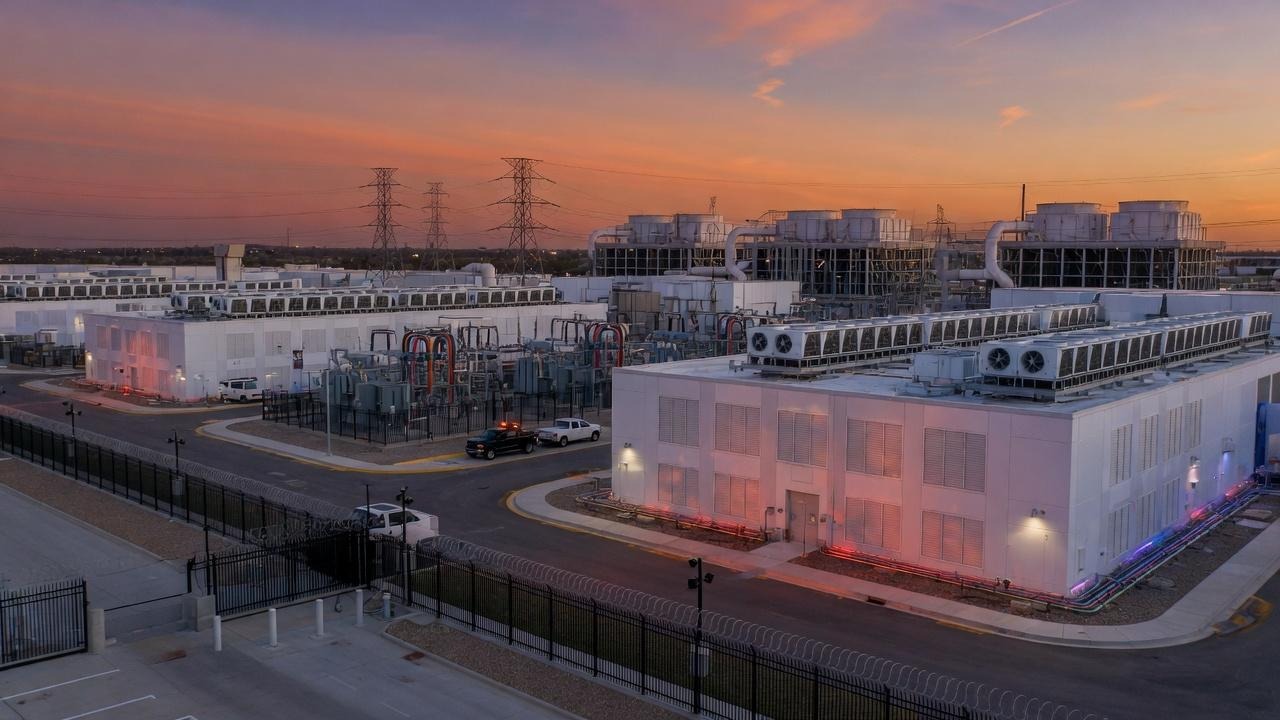
The convergence of forces is abstract until it becomes a building. A campus like this is where rising demand, the appetite for power, and the flow of capital all meet the ground.
Because such a campus takes years to complete, the decision to build it had to be made well before the demand it will serve fully arrives, which is the essence of why the buildout is happening now.
The three forces, looked at one by one
Demand
More capable models, mainstream adoption, and agentic systems all push compute demand higher at once, with no sign of leveling off in the near term.
Energy
The IEA reports AI data centre electricity surged about 50 percent in 2025 and projects overall demand to more than double by 2030, making power the central constraint.
Capital
Investment is flowing in at scale to fund chips, power agreements, and facilities, which is what turns demand into physical construction.
Understanding the buildout is not a buy signal
It is easy to slide from explaining why the buildout is happening now to implying that now is therefore the right time to act. That slide is not justified. Understanding the forces behind the buildout tells you why it is occurring. It does not tell you whether participating fits your goals, and it certainly does not promise a result.
The projections themselves are not certainties. The IEA's figures describe expected trajectories, not guarantees, and demand could grow faster, slower, or unevenly. Reading the buildout clearly should make you better informed, not more pressured. A clear explanation of why something is happening is a tool for thinking, not a recommendation to act.
From understanding the buildout to taking a position
Understanding why the buildout is happening now can inform a decision, but it cannot make it for you. If a position in AI compute fits your goals, one practical route is owning a physical NVIDIA machine that a professional team operates inside an American data center. Golden Core Mining is built around that model, and you can read how it works on our managed GPU compute page.
Decide on your own timeline and with clear eyes. The buildout being real does not guarantee any outcome, and owning hardware carries real costs and risks. Operational benefits depend on utilization, uptime, demand, costs, hardware performance, and market conditions, regardless of how the buildout unfolds.
References and data
- Energy and AI. International Energy Agency (IEA). April 2025.
- Key Questions on Energy and AI. International Energy Agency (IEA). 2025.
Questions about the AI buildout timing
Because demand, energy needs, and capital are converging at once, and because physical capacity takes years to build. To have facilities ready when demand arrives, developers must commit now. The IEA reports AI-focused data centre electricity surged about 50 percent in 2025.
Power on the scale AI needs cannot be switched on overnight. Securing generation, grid interconnection, and cooling takes years, and the equipment is itself scarce. The appetite for power is immediate while delivery lags, so developers must commit early. The IEA projects demand to more than double to roughly 945 TWh by 2030.
A data center campus needs land, permits, power agreements, construction, and commissioning, a sequence measured in years. To have capacity ready when demand arrives, builders must start before they can be certain how much will be needed.
Pressure appears likely to continue, since three reinforcing forces do not switch off quickly. The IEA projects data centre electricity demand to more than double by 2030, though projections are expected trajectories, not certainties, and no outcome is guaranteed.
Understanding the buildout can inform a decision, but it does not make it for you and guarantees nothing. Owning hardware carries real costs and risks, and operational benefits depend on utilization, demand, costs, and market conditions.
Talk with us about AI infrastructure ownership
Share your name, phone, email, and which managed device tier interests you. We will reach out with a clear walkthrough. No pressure.
Request received
Thank you. We will contact you at the phone number or email you provided.
Want a position as the buildout accelerates?
Talk through what owning managed NVIDIA GPU hardware would look like, with no pressure and straight answers.
Operational benefits are not guaranteed and depend on utilization, uptime, demand, costs, hardware performance, and market conditions.